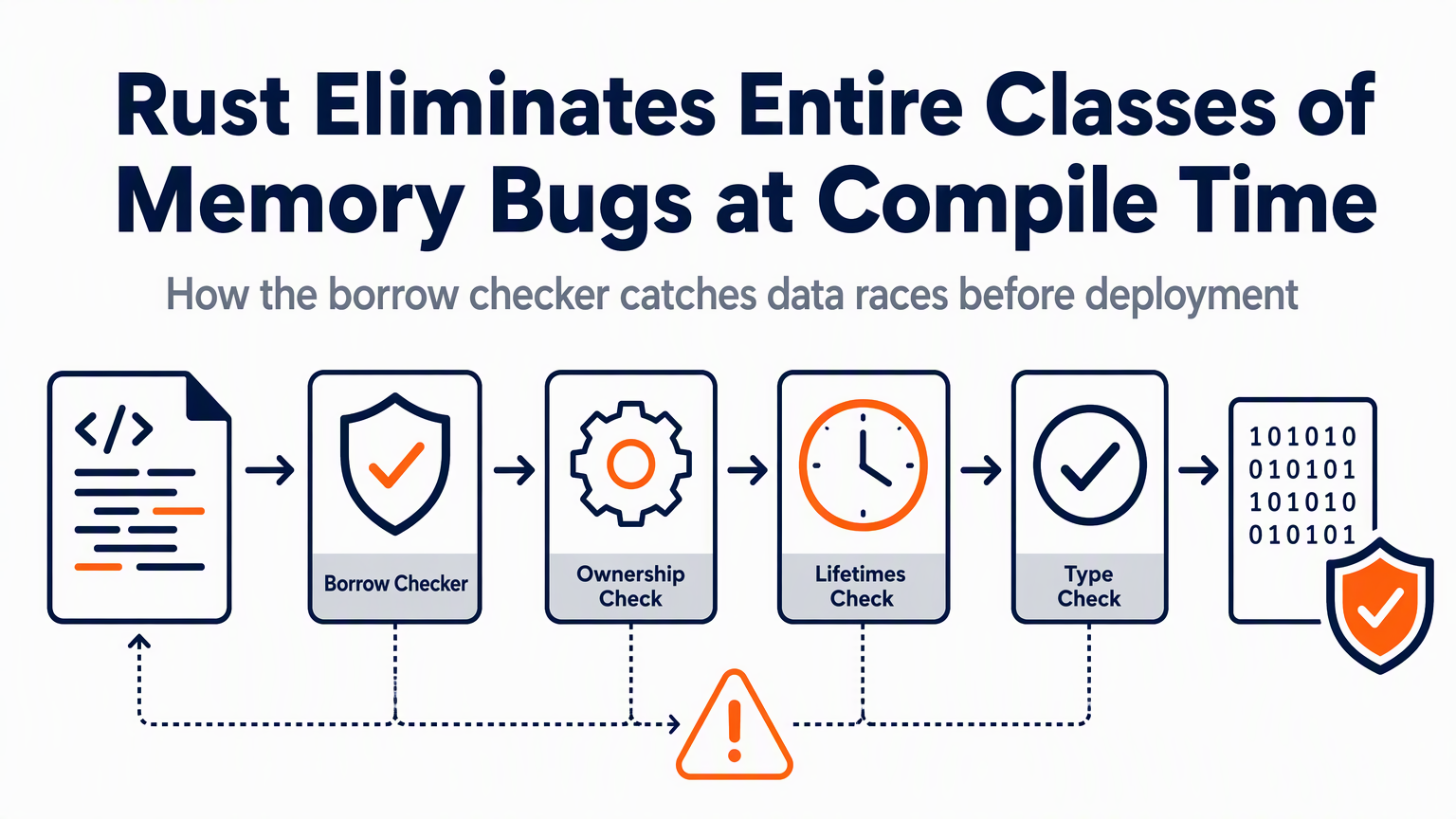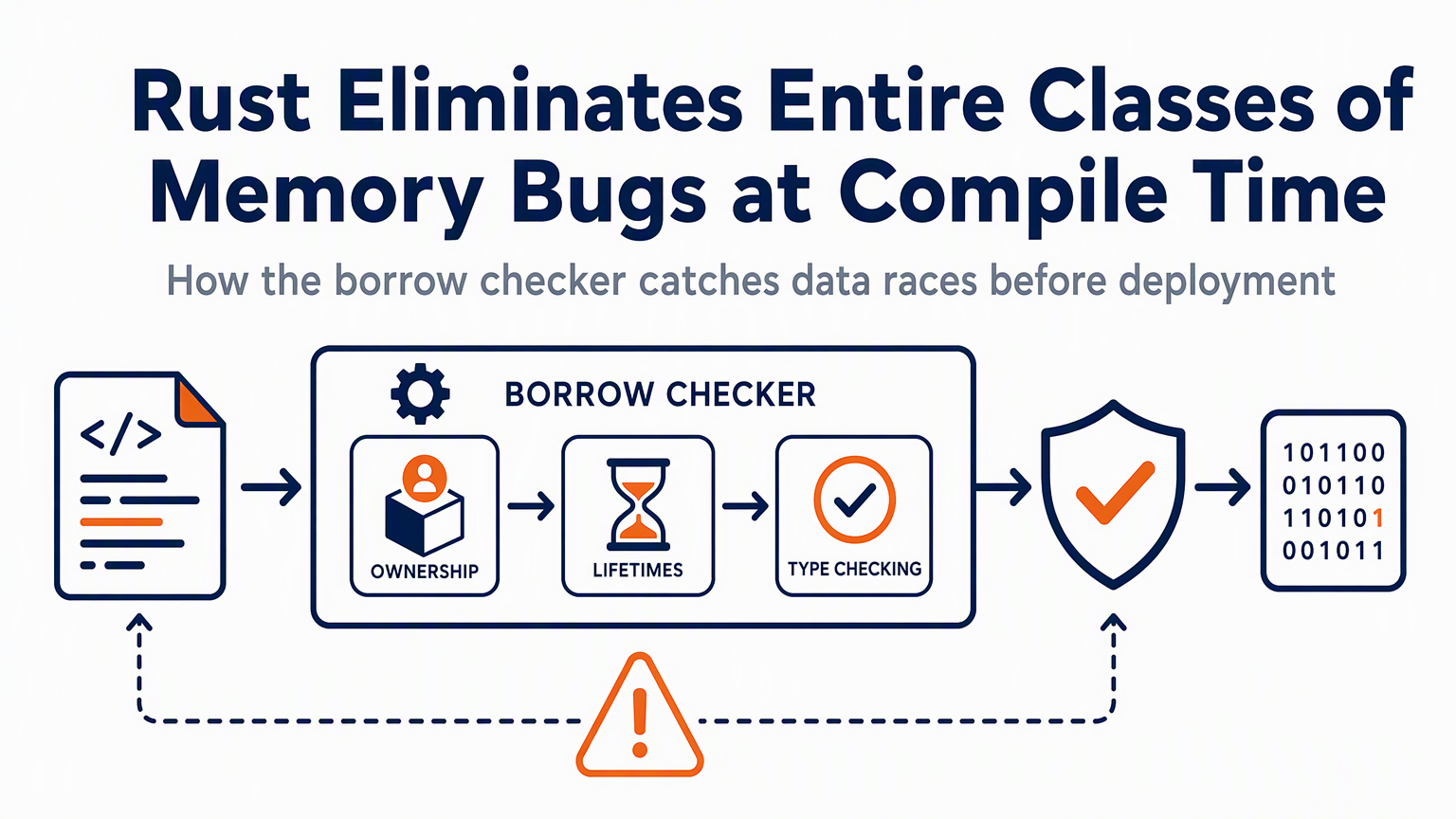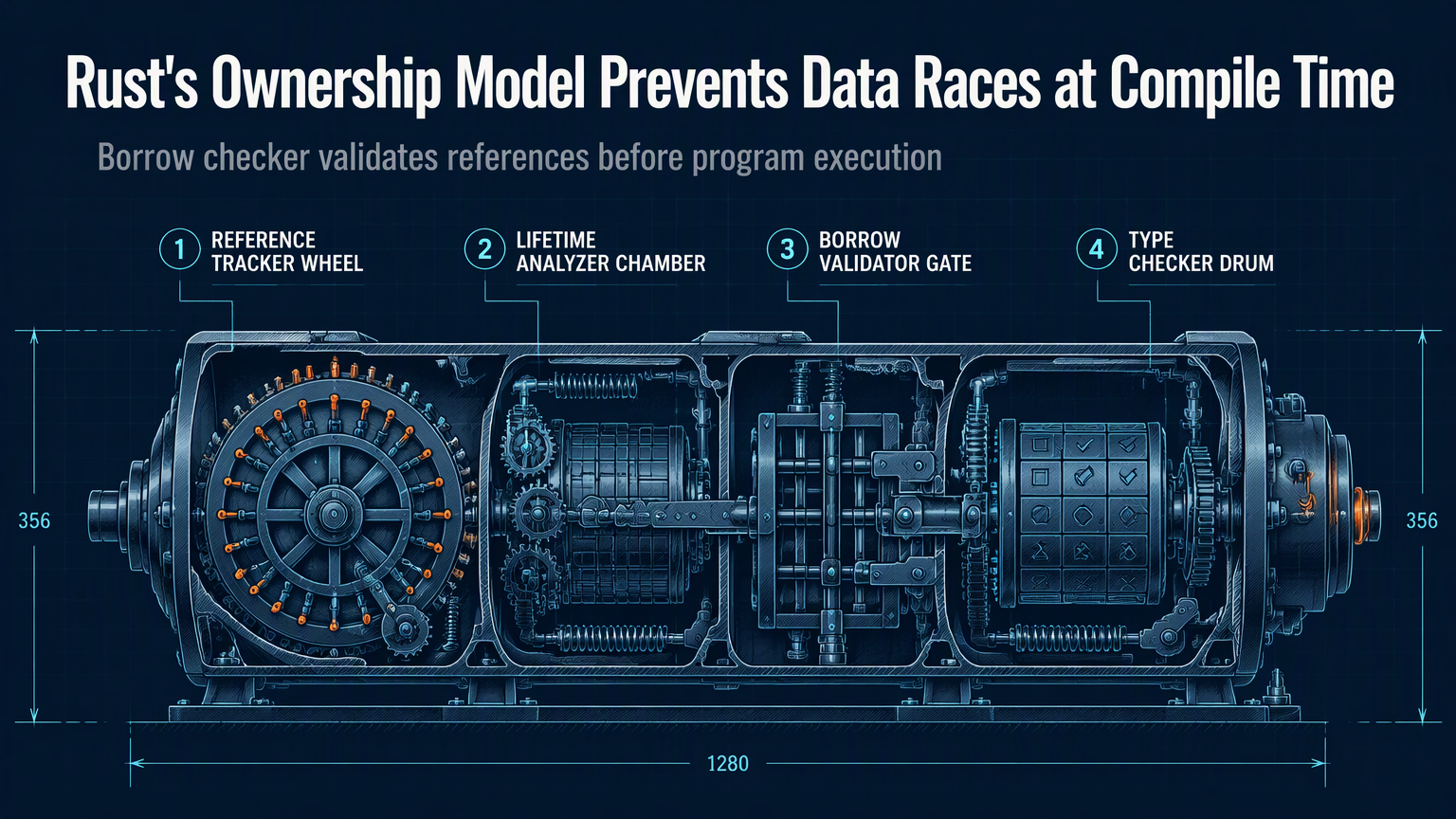
Most languages catch data races at runtime — if they catch them at all. Rust catches them before your code compiles. The ownership model isn't just a memory management trick; it's a concurrency guarantee baked into the type system.
The Core Rule: One Mutable Reference or Many Immutable
Rust enforces a simple but powerful constraint: at any given time, you can have either one mutable reference to a piece of data or any number of immutable references — never both. This rule alone eliminates the classic read-write and write-write conflicts that plague concurrent code in C++, Java, and Go.
The compiler tracks lifetimes and scopes precisely. When r1 and r2 go out of scope, the mutable borrow becomes legal again. No runtime checks. No locks. Just static analysis.
Send and Sync: Traits That Enforce Thread Safety
Ownership enables two marker traits that make concurrency safe by construction:
- Send — types safe to transfer across threads (ownership moves)
- Sync — types safe to share across threads (&T is Send)
Most types implement both automatically. Rc<T> doesn't implement Send or Sync — so you can't accidentally share reference-counted data across threads. Arc<T> does, but only when T is Sync. The compiler stops you from shooting yourself in the foot.
💡
TipIf a type contains a raw pointer or <code>UnsafeCell</code>, you must manually implement <code>Send</code>/<code>Sync</code> — and prove it's safe. The compiler trusts you only when you opt in.
Interior Mutability Without Data Races
Sometimes you need mutation through a shared reference. RefCell<T> and Mutex<T> provide this — but they enforce borrowing rules at runtime (RefCell) or via locking (Mutex). Both prevent data races:
The Mutex ensures only one thread accesses the data at a time. The Arc ensures safe shared ownership. Try to access the data without locking — the compiler won't let you.
"Rust's type system turns data races into compile errors. That's not a slogan — it's a theorem proven by the borrow checker.
— Niko Matsakis, Rust Core Team
Fearless Concurrency in Practice
This model enables patterns that are terrifying in other languages:
- Parallel iterators with
rayon— no manual thread management - Async runtimes like
tokio— thousands of tasks, zero data races - Lock-free data structures — verified by the type system
ℹ️
NoteThe borrow checker rejects code that *might* race. False positives happen — but they're far cheaper than debugging a heisenbug in production.
✦
Start Writing Race-Free Code Today
Pick a small concurrent task — a log aggregator, a cache, a worker pool. Write it in Rust. Let the compiler yell at you. Fix each error. When it compiles, you've eliminated an entire class of bugs before running a single test. That's not magic. That's ownership.