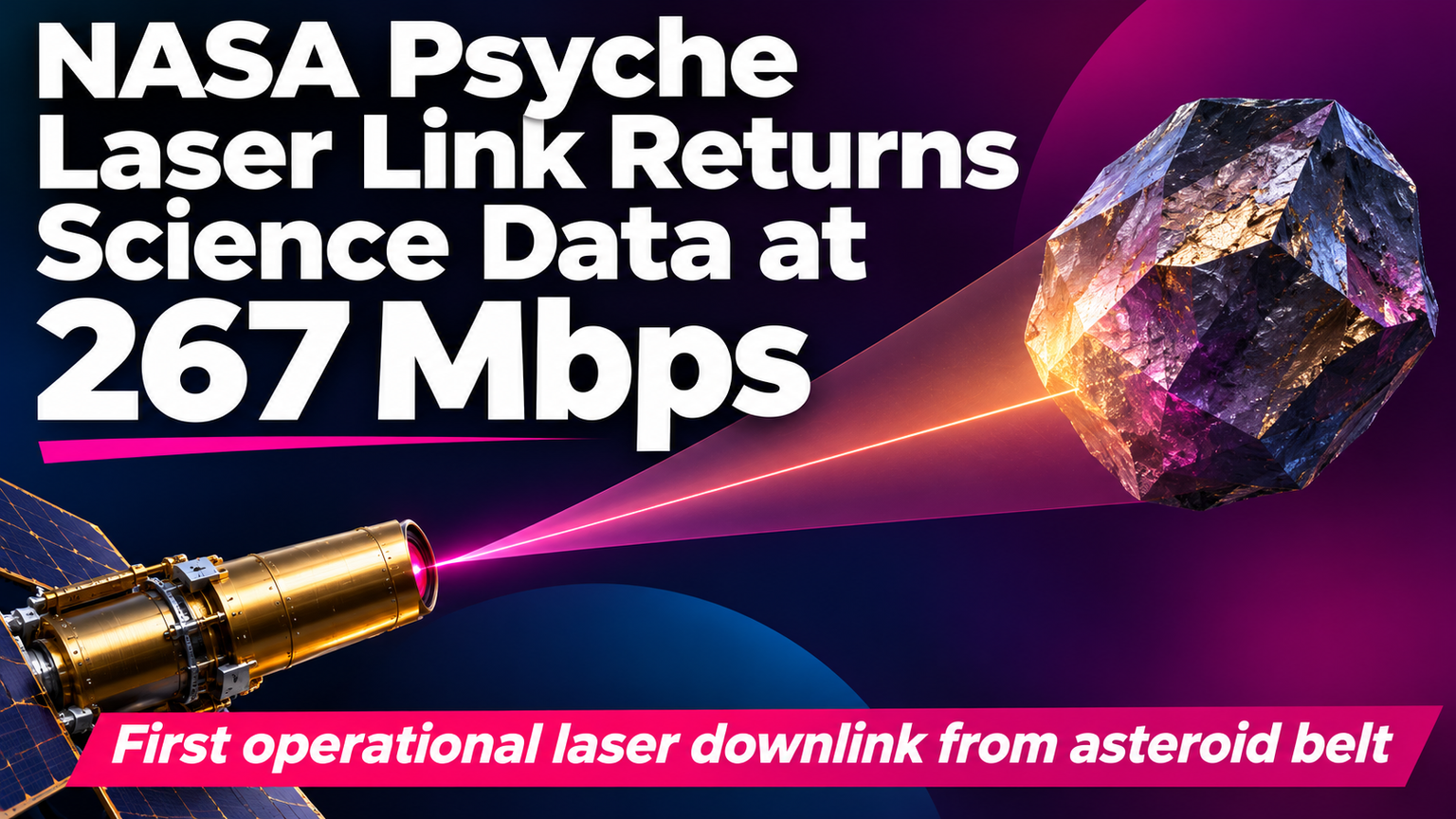
NASA's Deep Space Optical Communications (DSOC) experiment aboard the Psyche spacecraft just proved that lasers can haul serious bandwidth from the asteroid belt. The flight transceiver locked onto the Hale Telescope at Palomar and downlinked engineering and science data at a sustained 267 megabits per second. That is not a typo. It is roughly 10 to 100 times faster than the best radio frequency links operating at comparable distances.
Why This Changes Deep Space Operations
Radio spectrum is crowded and physics limits its data rate. Optical wavelengths are 10,000 times shorter, allowing narrower beams and higher photon density. For mission designers, this means high-resolution imaging, hyperspectral mapping, and even video streaming from the outer solar system become realistic. The Psyche demo transmitted a copy of the spacecraft's own engineering telemetry plus a segment of the mission's science data archive, validating the full data pipeline from instrument to ground.
"We are moving from dial-up to broadband in deep space. This link margin gives us the headroom to design instruments that generate data first and worry about downlink second.
— Dr. Abi Biswas, DSOC Project Technologist, JPL
The Link Budget in Practice
| Parameter | Value |
|---|---|
| Distance at test | ~1.5 AU (225 million km) |
| Downlink rate | 267 Mbps sustained |
| Uplink rate | 25 Mbps (ground laser) |
| Flight transceiver aperture | 22 cm |
| Ground receiver aperture | 5.1 m (Hale Telescope) |
| Wavelength | 1550 nm (eye-safe IR) |
The 22 cm flight terminal uses a photon-counting detector array and a vibration-isolated gimbal to maintain sub-microradian pointing. On the ground, the Hale Telescope couples collected photons into superconducting nanowire single-photon detectors (SNSPDs) cooled below 1 Kelvin. The system operates photon-starved; every detected photon carries roughly 4 bits of information thanks to advanced modulation (PPM) and low-density parity-check (LDPC) coding.
💡
TipEngineers integrating optical terminals: budget 3-5 kg and 50-100 W for the flight transceiver. Pointing stability is the dominant driver — invest in micro-vibration isolation early.
Operational Realities
Clouds block optical links. DSOC mitigates this with a network of geographically diverse ground stations (Table Mountain, Palomar, and future sites in the southern hemisphere). The protocol includes automatic rate adaptation and buffering; when clouds roll over Palomar, the spacecraft holds data and retransmits at the next clear pass. Latency at 1.5 AU is roughly 12.5 minutes one-way, so the link layer must handle long round-trip times without TCP-style congestion collapse.
What Comes Next
DSOC is a technology demonstration, not an operational service. The next phase integrates optical terminals into the Near Space Network and Deep Space Network as standard services. Artemis missions will carry optical terminals for lunar video. Mars Sample Return plans assume optical downlink for high-volume science return. Commercial providers are already leasing ground station apertures for optical feeder links.
ℹ️
NoteNASA's Laser Communications Relay Demonstration (LCRD) in GEO and the upcoming ILLUMA-T on ISS provide the near-Earth optical backbone. DSOC extends that architecture to interplanetary distances.
✦
The 267 Mbps milestone is a proof point: photonics works where photons are scarce. If you are designing a payload for the 2030 launch window, baseline optical downlink. Size your instrument data rates to the link, not the other way around. The bandwidth is there — go fill it.