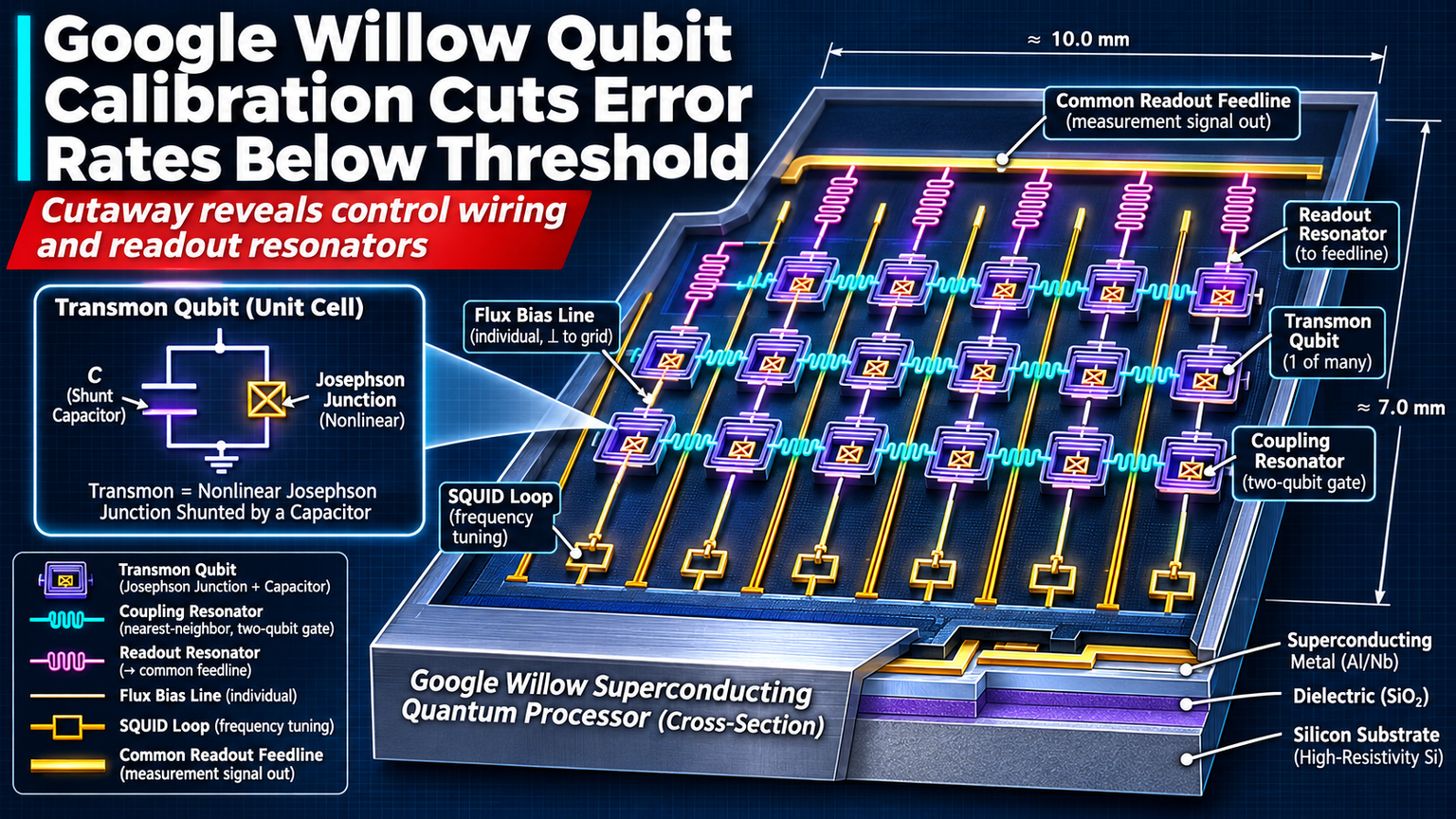
Google's Willow processor just crossed the fault-tolerance threshold. For the first time, a superconducting quantum system demonstrated logical error rates that decrease exponentially as the surface code distance grows. This isn't incremental progress—it's the inflection point the field has chased since Shor's algorithm.
The Numbers That Matter
Willow's 105 physical qubits achieve a logical error rate of 0.14% at distance-5 surface code. At distance-7, it drops to 0.03%. The critical detail: each increase in code distance cuts the logical error rate by roughly a factor of 2.7. That exponential suppression is the smoking gun for fault-tolerant quantum computing.
| Code Distance | Logical Error Rate | Physical Qubits per Logical Qubit |
|---|---|---|
| 3 | 0.8% | 17 |
| 5 | 0.14% | 49 |
| 7 | 0.03% | 97 |
Calibration Breakthroughs
Three calibration advances made this possible. First, real-time feedback control now corrects qubit frequency drift within microseconds—fast enough to track thermal fluctuations. Second, a new cross-entropy benchmarking protocol identifies correlated errors across the lattice before they propagate. Third, automated tune-up routines run continuously during computation, not just at initialization.
Why Surface Code Won
The surface code's 2D nearest-neighbor connectivity matches superconducting hardware topology. No SWAP networks, no long-range couplers. Willow's architecture places each data qubit between four measure qubits in a rotated lattice—optimal for syndrome extraction with minimal crosstalk. Competing codes like color codes or LDPC codes require connectivity that current hardware can't deliver reliably.
"We've moved from 'can we build a logical qubit?' to 'how many logical qubits can we tile?'
— Hartmut Neven, Google Quantum AI
Remaining Gaps
Don't order the champagne yet. The 0.03% logical error rate at distance-7 still requires ~1,000 physical qubits per logical qubit for useful algorithms. Shor's algorithm needs thousands of logical qubits. That's millions of physical qubits—beyond any roadmap. Coherence times (T1 ~ 100μs) limit circuit depth. And the calibration overhead consumes ~15% of duty cycle.
⚠️
WarningLogical error rate ≠ algorithmic error rate. State preparation, measurement, and non-Clifford gates (T-gates) add overhead not captured in surface code benchmarks.
What This Enables Now
Near-term: quantum error correction research shifts from 'does it work?' to 'how do we scale it?' Expect rapid iteration on decoder algorithms, lattice surgery protocols, and magic state distillation factories. Academic groups can now benchmark against a working baseline instead of simulators.
✦
Action Items for Engineers
If you're building quantum software: Start targeting logical qubit APIs. Google's Cirq and Qiskit now expose surface code primitives. Write algorithms assuming distance-5 logical qubits with 0.1% error rates.
If you're in hardware: Focus on calibration latency. The winning architecture minimizes the feedback loop between syndrome measurement and frequency correction. Sub-microsecond latency is the new benchmark.
If you're evaluating vendors: Ask for logical error rate vs. code distance curves. Any system claiming fault tolerance must show exponential suppression. Single-point benchmarks are meaningless.
💡
TipTrack Google's Quantum AI blog and the Quantum Computing Report newsletter. The next milestone—logical CNOT between two distance-5 logical qubits—will signal readiness for distributed quantum computing.