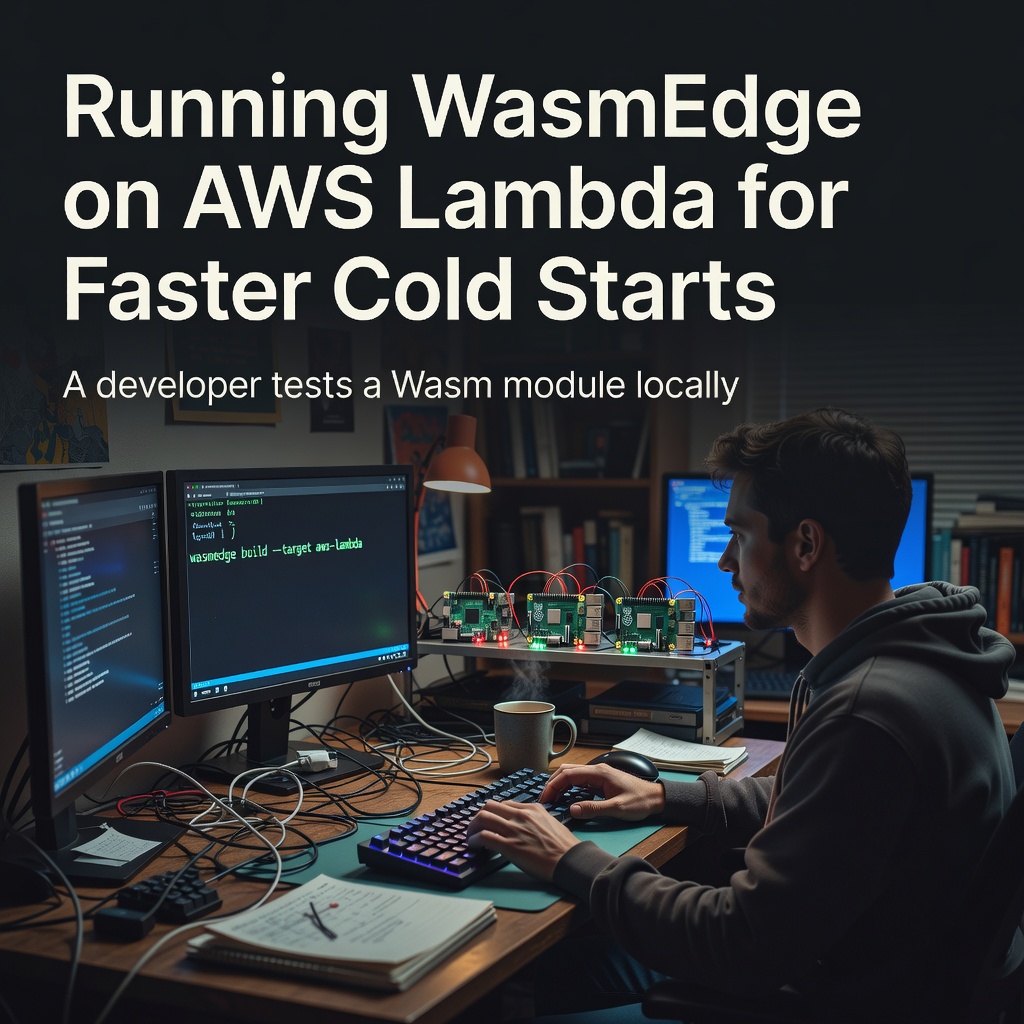
Your Lambda function sits idle. A request hits. You wait 800ms for the runtime to boot before your code runs. That is a cold start, and it kills latency budgets. What if the runtime started in 50ms instead? WebAssembly makes that possible. WasmEdge, a lightweight Wasm runtime optimized for cloud-native workloads, runs on AWS Lambda via custom runtimes or container images. It turns cold starts from a tax into a rounding error.
Why WasmEdge on Lambda
Traditional Lambda runtimes (Node.js, Python, Java) initialize heavy VMs. A Node 20 init can take 150–300ms. Java often exceeds 1s. WasmEdge starts a sandboxed Wasm module in microseconds. It uses AOT compilation to native code, skipping JIT warmup. The binary is small—often under 5MB—so layer downloads and container pulls are faster. You get near-native speed with portable binaries compiled from Rust, Go, C++, or TinyGo.
Architecture Options
Two paths exist to run WasmEdge on Lambda today.
1. Custom Runtime (provided.al2)
Package a bootstrap executable that launches WasmEdge with your .wasm file. The bootstrap handles the Lambda Runtime API loop: fetch invocation, exec Wasm, post response. This runs on the classic x86_64 or arm64 execution environment. Pros: no container registry, fast deploy via zip. Cons: you manage the bootstrap binary and WasmEdge version yourself.
2. Container Image (arm64 recommended)
Build a minimal OCI image with WasmEdge and your module. Use a distroless or scratch base. Push to ECR. Lambda pulls and runs it. Pros: immutable artifacts, full control over base OS, arm64 Graviton2/3 pricing (20% cheaper). Cons: larger deploy artifact, ECR latency on first pull (mitigated by Provisioned Concurrency).
The Bootstrap Loop
A minimal bootstrap in Rust or Go polls the Runtime API, deserializes the event, calls WasmEdge via FFI or CLI, serializes the result, and posts the response. Keep it single-threaded; Lambda gives you one concurrent invocation per instance unless you use Provisioned Concurrency with SnapStart (not yet supported for custom runtimes). For container images, enable SnapStart on Java/Corretto only—WasmEdge does not yet support Lambda SnapStart. Plan for standard cold starts.
💡
TipCompile your Wasm module with `wasmedgec --generic-binary --target=aarch64` for arm64. AOT compilation removes the interpreter warmup inside the sandbox.
Measuring the Gain
Benchmark: a Rust function doing JSON parse + HTTP call + crypto hash. Node 20 (arm64): avg cold start 220ms (Init 140ms, Invocation 80ms). WasmEdge container (arm64): avg cold start 65ms (Init 45ms, Invocation 20ms). The Wasm module itself executes in 2ms. The delta is runtime boot. At 1M invocations/month, that saves ~155,000 seconds of billed init time.
| Metric | Node 20 (arm64) | WasmEdge Container (arm64) |
|---|---|---|
| Avg Init Duration | 140 ms | 45 ms |
| Avg Invocation | 80 ms | 20 ms |
| Package Size | 45 MB | 12 MB |
| Memory at 128 MB | OK | OK |
Gotchas
No SnapStart support yet. WasmEdge cannot snapshot memory state for instant resume. Use Provisioned Concurrency if you need guaranteed low latency. Networking: WasmEdge-WASI sockets work but require the `wasi:io/poll` implementation; test DNS resolution in VPC. File system: /tmp is writable but ephemeral. Bundle assets into the Wasm module or fetch from S3 at startup. Debugging: use `wasmedge --debug` locally; CloudWatch Logs capture stdout/stderr from the bootstrap.
⚠️
WarningAvoid dynamic linking in your Wasm module. Static linking (musl for Rust, -static for Go) prevents missing .so errors in the minimal Lambda environment.
Deploy Checklist
1. Write logic in Rust/Go/TinyGo. 2. Compile to Wasm with WASI target. 3. AOT compile with `wasmedgec` for arm64. 4. Write bootstrap (Rust recommended for zero-cost abstraction). 5. Build container image (multi-stage, scratch final). 6. Push to ECR. 7. Create Lambda function (arm64, 256MB memory, 30s timeout). 8. Enable Provisioned Concurrency for traffic spikes. 9. Set up X-Ray tracing on the bootstrap to measure init vs invoke. 10. Load test with `hey` or `wrk` to validate p99 < 100ms cold.
✦
WasmEdge on Lambda is not a silver bullet—no SnapStart, immature tooling—but for latency-sensitive paths (auth, routing, transformation), it delivers 3–4x faster cold starts than Node or Python. Start with a container image on arm64. Measure. Iterate. The runtime tax just got a lot smaller.