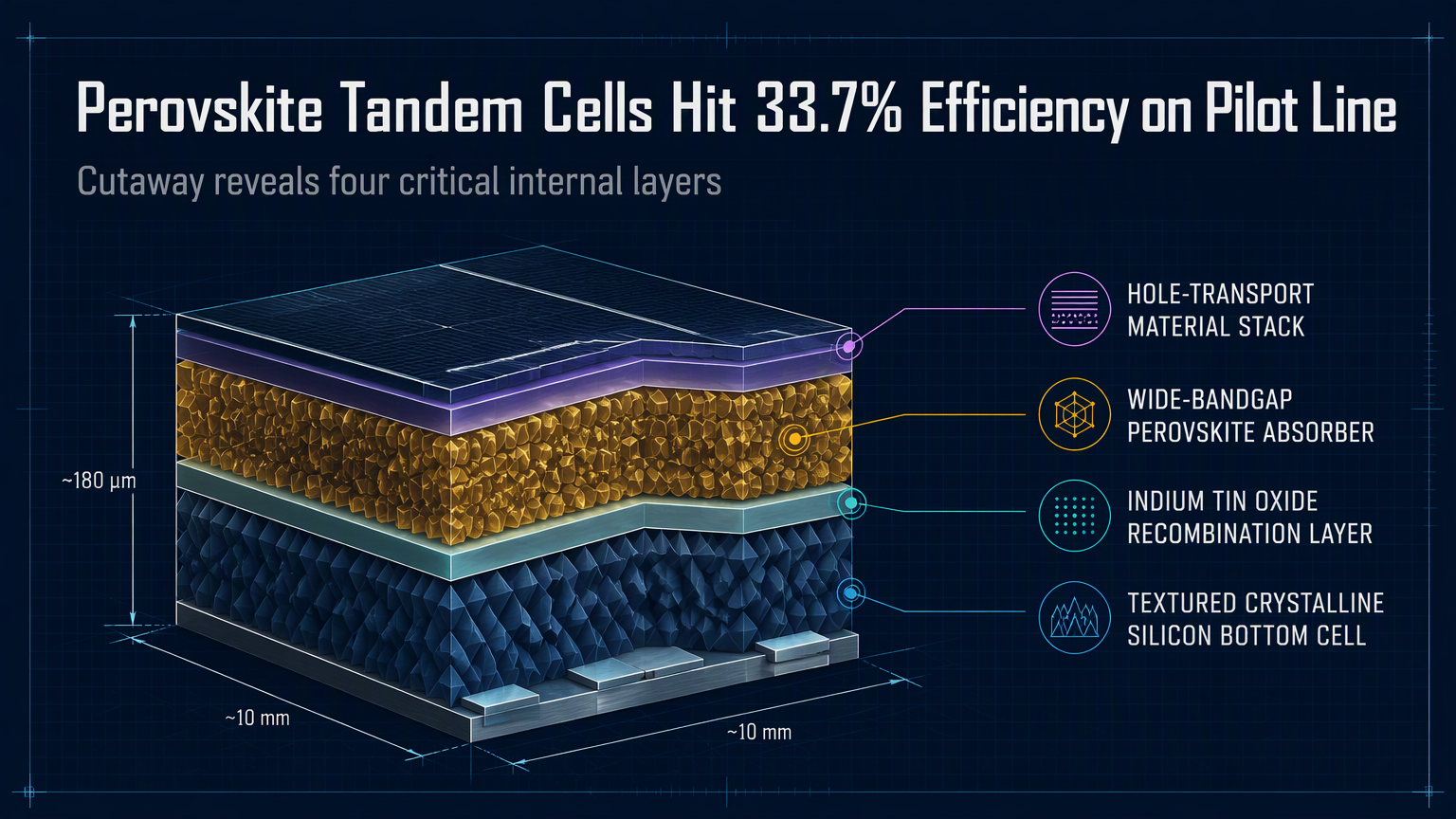
Perovskite-silicon tandem solar cells just cleared a hurdle that has separated lab bragging rights from bankable products. Oxford PV's Brandenburg pilot line produced a full-size module at 33.7% aperture-area efficiency — certified by Fraunhofer ISE — marking the first time a commercial-scale tandem has cracked the 33% barrier outside a test fixture.
Why This Number Matters
The single-junction silicon Shockley-Queisser limit sits at 29.4%. Every percentage point above that translates directly to watts per square meter — and dollars per megawatt-hour. At 33.7%, a standard 72-cell tandem module delivers roughly 485 W versus 410 W for today's best PERC silicon. That's 18% more energy from the same racking, land, and balance-of-system costs.
| Metric | Best Silicon (TOPCon) | Oxford PV Tandem Pilot |
|---|---|---|
| Cell efficiency (cert.) | 26.8% | 28.6% |
| Module aperture efficiency | 22.8% | 33.7% |
| Power per 2.3 m² module | 410 W | 485 W |
| Degradation (damp heat 3k hrs) | < 2% | < 3% |
| Est. manufacturing cost | $0.22/W | $0.28/W (target $0.20/W) |
The Encapsulation Breakthrough
Efficiency headlines grab attention, but the real story is stability. Perovskites degrade fast under heat, humidity, and UV — the exact conditions on a rooftop. Oxford PV's pilot modules passed IEC 61215 damp-heat (85°C/85% RH, 3,000 hours) with under 3% degradation, thanks to a proprietary edge-seal glass-glass laminate and a wide-bandgap perovskite composition (Cs/FA/MA with Br/I tuning) that suppresses ion migration.
"We've moved from 'can we make it efficient?' to 'can we make it survive 25 years in Florida?' The pilot line proves the answer is yes — if you control the interface chemistry at scale.
— Dr. Chris Case, CTO, Oxford PV
Manufacturing Reality Check
The Brandenburg line runs at 100 MW/year — tiny compared to GW-scale silicon fabs. But it validates the process flow: silicon bottom cell (heterojunction), sputtered ITO, slot-die coated perovskite, thermal evaporation for top contact, then laser scribing for series interconnection. Yield on the pilot line hit 92% for modules passing 33% efficiency. The bottleneck isn't deposition — it's inline metrology for perovskite thickness uniformity across 1.3 m² substrates.
ℹ️
NoteChinese manufacturers (Longi, Jinko, TCL Zhonghuan) hold 68% of global perovskite tandem patents. Oxford PV leads on European IP and pilot-line data. The first GW-scale tandem fab will likely be a joint venture.
LCOE Impact: When Do Tandems Win?
At current pilot-line costs ($0.28/W), tandems only pencil out for space-constrained rooftops where land premium exceeds $50/W. But the learning curve is steep. Oxford PV targets $0.20/W at 1 GW/year — achievable by 2028 if supply chains for high-purity formamidinium iodide and specialized slot-die heads mature. At that cost, tandem LCOE beats silicon in all utility markets with irradiance > 1,400 kWh/m²/yr.
What's Next: Bankability Checklist
Three gates remain before utility developers sign PPAs for tandem farms:
1. IEC 61730 safety certification (lead leakage, fire class) — expected Q1 2027.
2. 1,000-module field deployment with 12-month degradation data — underway with Enel Green Power in Sicily.
3. Insurance-backed performance warranty — Munich Re and Swiss Re are drafting terms now, keyed to damp-heat + UV-seq combined stress testing.
💡
TipIf you're procuring utility PV for 2027-2028 COD, write tandem optionality into EPC contracts now: price caps for >32% modules, warranty step-downs tied to IEC 61730 clearance.
✦
The 33.7% pilot-line module isn't a lab curiosity — it's a manufacturing proof point. Perovskite tandems have crossed from physics problem to engineering discipline. The next 24 months will decide whether they become the new silicon or remain a niche premium product. Watch the encapsulation supply chain and the insurance markets — they'll signal bankability before any press release does.