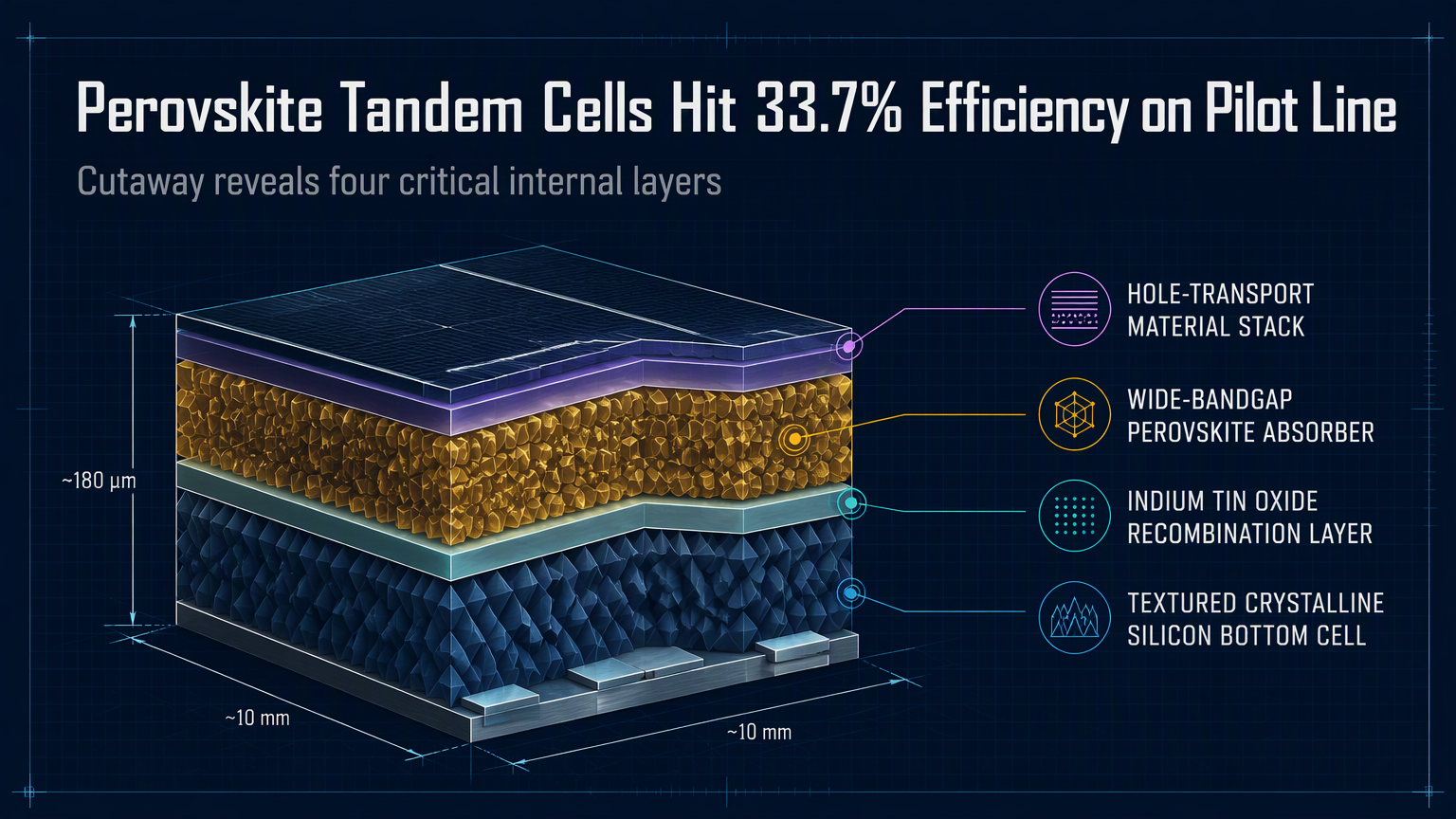
Perovskite solar cells just shattered the efficiency ceiling again. In July 2026, LONGi certified a perovskite-silicon tandem cell at 34.6% efficiency — a full percentage point above the previous record set just six months earlier. For context, the best commercial silicon modules top out around 24-25%. That gap isn't academic; it's the difference between a rooftop that powers your home and one that powers your neighborhood.
Why This Matters Now
The perovskite story has always been about potential versus reality. The material class — crystals with an ABX3 structure — absorbs light across a broader spectrum than silicon, costs less to process, and can be printed on flexible substrates. But stability killed commercial hopes for a decade. Moisture, heat, and light itself degraded early cells in days.
That changed in 2024-2025. Encapsulation breakthroughs at Oxford PV and academic labs pushed operational lifetimes past 25 years in accelerated testing (IEC 61215:2021). The industry converged on 2D/3D perovskite heterostructures, inorganic transport layers, and wide-bandgap compositions that resist phase segregation. Pilot lines in Germany, China, and the US now produce meter-scale modules with <5% degradation after 1,000 hours damp-heat exposure.
Efficiency Landscape: Certified Records (July 2026)
| Configuration | Efficiency | Holder | Date |
|---|---|---|---|
| Perovskite/Si tandem (2T) | 34.6% | LONGi | Jul 2026 |
| Perovskite/Si tandem (4T) | 33.9% | Oxford PV | Mar 2026 |
| Single-junction perovskite | 26.8% | KAUST/EPFL | Jan 2026 |
| All-perovskite tandem | 29.1% | NREL/UNC | Nov 2025 |
| Commercial Si reference | 24.9% | LONGi/Jinko | 2025 avg |
ℹ️
Note2T = two-terminal (monolithic), 4T = four-terminal (mechanically stacked). 2T leads on efficiency; 4T leads on manufacturing simplicity.
Manufacturing Scale-Up Status
Oxford PV's Brandenburg factory ships commercial tandem modules since Q4 2024. Qcells (Hanwha) targets 2026 pilot production in Georgia, USA. LONGi's new Sichuan line aims for 5 GW tandem capacity by 2027. But yield remains the bottleneck: perovskite deposition uniformity over >1 m2 substrates still lags silicon's maturity. Slot-die coating and thermal evaporation compete; no clear winner yet.
""We're not fighting physics anymore. We're fighting yield curves and supply chains."
— Dr. Chris Case, CTO Oxford PV
Bankability and LCOE Trajectory
Levelized cost of electricity (LCOE) models from NREL and BNEF show perovskite tandems reaching parity with silicon utility-scale ($0.025-0.035/kWh) by 2028-2030, assuming 25-year warranties and >90% capacity factor retention. The key variable: degradation rate. Field data from Oxford PV's 2023 pilot installations show 1.2%/year degradation — comparable to premium silicon. If that holds, bankability follows.
💡
TipInvestors: watch for IEC 61724-1 field performance data from >50 MW deployed capacity. That's the trigger for project finance.
Remaining Hurdles
Lead content (<0.1% by weight) requires recycling mandates — EU and US regulations incoming 2027. Hysteresis in J-V curves complicates inverter MPPT algorithms. And the industry still lacks a standardized accelerated test that correlates perfectly with 25-year field life. NREL's new "Perovskite Durability Protocol" (2025) is the closest consensus.
✦
What to Watch Next
Track these signals through 2026: (1) First 100 MW+ utility tender won by perovskite tandem. (2) Major inverter vendor (Huawei, Sungrow, SMA) releasing perovskite-optimized MPPT firmware. (3) Insurance consortium backing 25-year warranty. Any one de-risks the next.
⚠️
WarningDon't bet on single-junction perovskite for utility scale. Tandem is the only path that beats silicon on $/W installed.