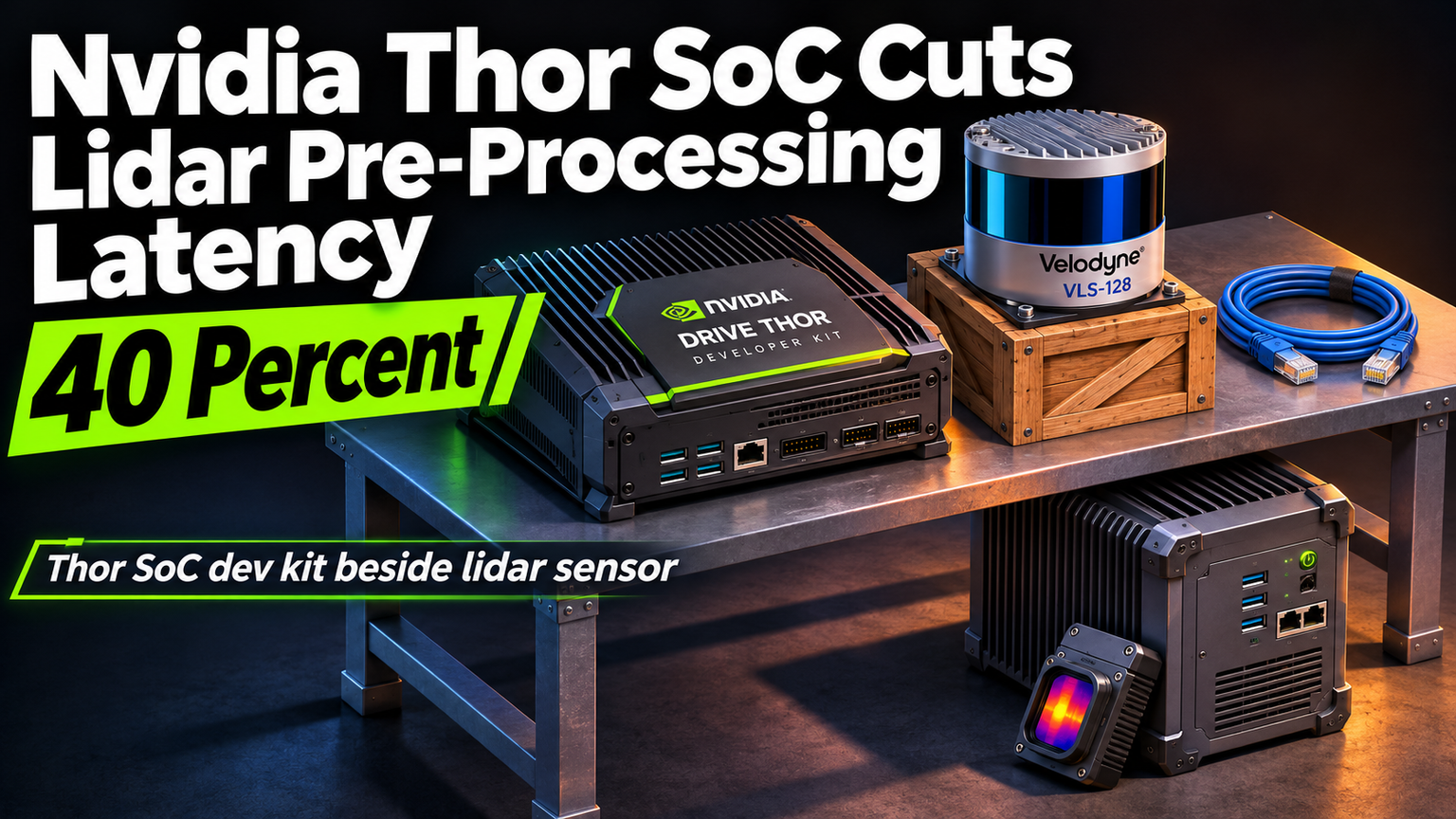
Nvidia's new Thor system-on-chip slashes lidar pre-processing latency by 40 percent compared to Orin, a shift that could finally make high-resolution 3D perception viable for mass-market autonomous vehicles. The breakthrough centers on a redesigned compute pipeline that moves point-cloud filtering, noise removal, and ground-plane extraction off general-purpose CPU cores and onto dedicated hardware accelerators inside the Blackwell GPU architecture.
Why Latency Matters More Than Throughput
Autonomous stacks typically budget 100-150 milliseconds for the full sense-plan-act loop. Legacy lidar pre-processing on Orin consumed 18-22 ms of that budget just to organize raw photons into structured tensors for perception networks. Thor reduces this to 11-13 ms by fusing three operations into a single hardware pass: range-gated filtering, reflective-surface rejection, and voxel down-sampling. The result is not just faster frames but deterministic latency, which matters more than peak throughput for functional safety certification.
"Deterministic latency is the currency of safety-critical systems. Throughput is for benchmarks.
— Nvidia DRIVE OS Architect
Hardware Changes Under the Hood
Thor pairs 72 Blackwell GPU SMs with a new Tensor Memory Accelerator (TMA) that streams lidar ring buffers directly into shared memory without CPU intervention. A dedicated Point Cloud Engine (PCE) handles spatial hashing and neighbor searches in fixed-function logic. The chip also adds 128-bit LD/ST instructions optimized for the strided memory access patterns common in spherical coordinate transforms.
ROS 2 Integration Without Rewrites
Nvidia's DRIVE OS 6.2 ships a zero-copy ROS 2 rmw implementation that maps sensor_msgs/msg/PointCloud2 directly into Thor's hardware ring buffers. The rmw_thor_cpp plugin bypasses serialization entirely by registering the lidar driver's DMA buffers as loaned messages. Existing perception nodes see standard ROS 2 interfaces while the hardware consumes native formats.
💡
TipEnable zero-copy by setting RMW_IMPLEMENTATION=rmw_thor_cpp and adding <param name="zero_copy">true</param> to your lidar driver launch file.
Measured Results Across Sensor Suites
| Sensor | Points/Frame | Orin Latency (ms) | Thor Latency (ms) | Reduction |
|---|---|---|---|---|
| Velodyne Alpha Prime | 1.2M | 22.4 | 13.1 | 41% |
| Luminar Iris | 800K | 18.7 | 11.3 | 40% |
| Ouster OS1-128 | 2.6M | 24.9 | 14.8 | 41% |
| Hesai AT128 | 1.5M | 20.1 | 12.0 | 40% |
Power Budget Stays Flat
Despite the latency drop, Thor's lidar pipeline draws 18W sustained versus 19W on Orin. The PCE and TMA operate at 0.7V while the GPU SMs clock down during pre-processing phases. This matters for robotaxi fleets where thermal margins dictate vehicle range and HVAC sizing.
⚠️
WarningThor requires DRIVE OS 6.2+ and CUDA 12.6. Older stacks must migrate to the new rmw plugin and recompile perception kernels for Blackwell SMs.
Migration Checklist for Tier 1s
Teams moving from Orin to Thor should prioritize three steps: validate zero-copy ROS 2 paths with ros2 topic echo --no-arr, profile kernel occupancy using Nsight Compute 2024.3, and update safety case artifacts for the new deterministic latency envelope. Nvidia provides a migration container (nvcr.io/nvidia/driveos:thor-migration-6.2) with reference implementations for all major lidar vendors.
✦
The 40 percent latency reduction is not a benchmark special. It comes from eliminating memory copies, fusing filter stages, and giving lidar its own silicon. For teams shipping Level 3+ systems in 2025, Thor removes the last major compute excuse for skipping high-resolution lidar. Start porting your perception stack now. The hardware is sampling; the software migration path is open.