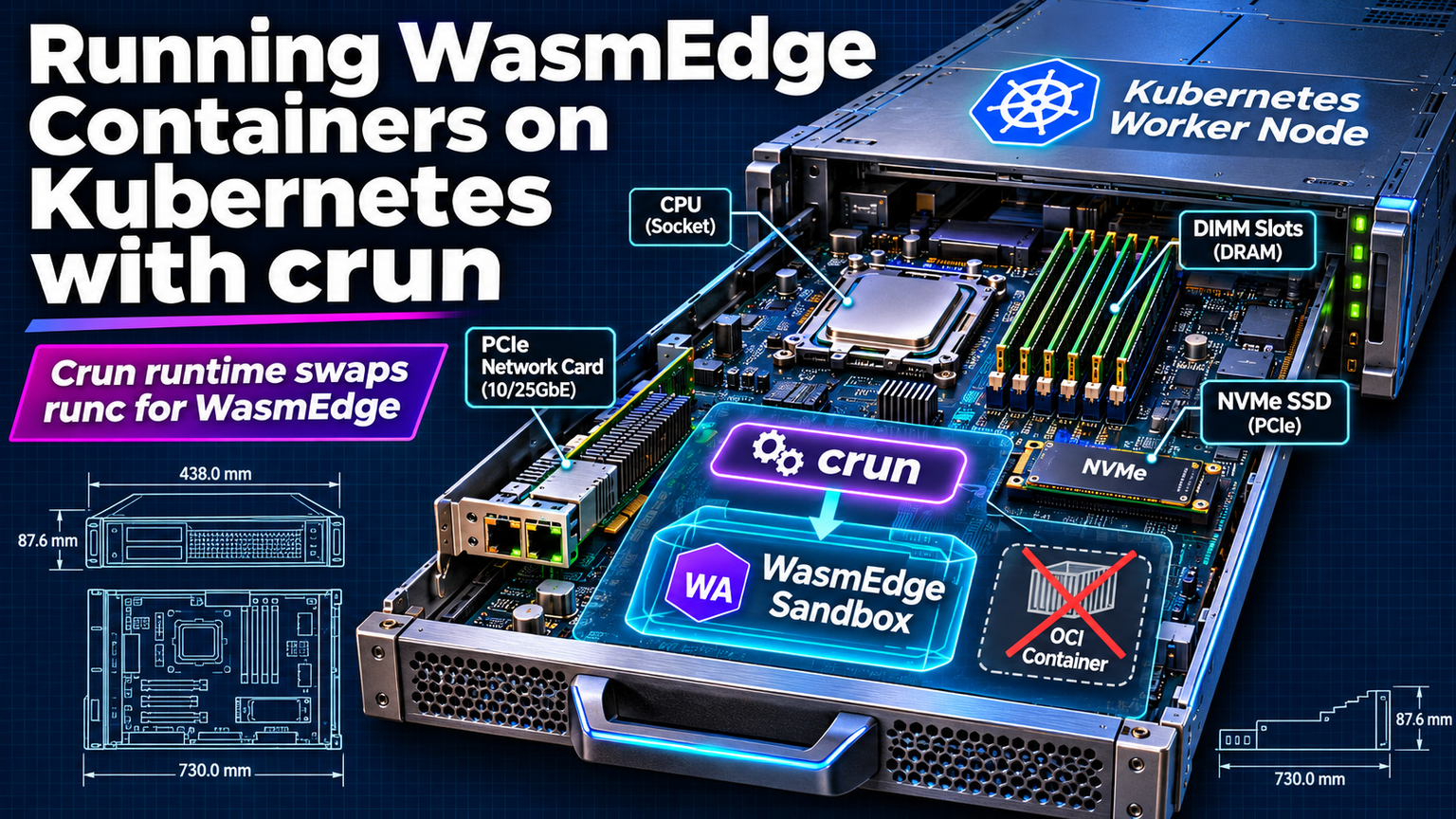
WebAssembly on the server isn't a science experiment anymore. It's a deployment target. If you're running Kubernetes, you can now schedule Wasm workloads right alongside standard Linux containers using the same tooling you already know: crun as the OCI runtime and containerd as the shim. No custom kubelet, no bespoke control plane, just a RuntimeClass and a few node labels.
Why WasmEdge on Kubernetes?
Cold starts in milliseconds. Near-native performance with a fraction of the attack surface. WasmEdge adds AOT compilation, POSIX-like system interfaces (WASI), and support for TensorFlow Lite and Rust async runtimes. For edge clusters, AI inference sidecars, or multi-tenant plugin systems, it changes the density equation entirely.
Prerequisites
You need a Kubernetes cluster (v1.25+), containerd v1.6+ configured with the CRI plugin, and nodes running a kernel >= 5.10 (for memfd_create and landlock support). Install crun >= 1.8 and wasmedge >= 0.13 on every worker node.
Configure containerd for WasmEdge
Edit /etc/containerd/config.toml to register a new runtime handler pointing at crun with the WasmEdge annotation.
💡
TipRestart containerd after changes: <code>systemctl restart containerd</code>.
Define the RuntimeClass
Create a RuntimeClass so the scheduler knows which nodes can run Wasm workloads.
Label Your Nodes
Taint or label nodes that have the WasmEdge binary installed. This prevents pods from landing on nodes without the runtime.
Build a Wasm Container Image
Compile your code (Rust, Go, C++) to wasm32-wasi. Package the .wasm file into a scratch image using a Dockerfile that sets the required annotation.
Push with the annotation so crun picks the right engine:
Deploy the Pod
Reference the RuntimeClass in your pod spec. The kubelet hands off to containerd, which invokes crun --annotation module.wasm.image/variant=wasmedge, launching WasmEdge.
Observability and Debugging
Standard kubectl logs and kubectl exec work. WasmEdge writes stdout/stderr normally. For profiling, enable WASMEDGE_LOG=debug in the container env. Metrics scrape via Prometheus annotations just like any other pod.
"The container image becomes a capability token, not a filesystem snapshot.
— Solomon Hykes
Next Steps
Start with a sidecar: move your auth proxy or metrics transformer to WasmEdge. Measure cold-start latency and memory footprint. Then expand to full services. The tooling is stable; the architecture shift is the only blocker.
⚠️
WarningEnsure your kernel supports <code>landlock</code> (5.13+) for proper sandboxing. Older kernels fall back to seccomp-only isolation.
✦
Clone the WasmEdge repo, spin up a kind cluster with the containerd config above, and deploy the sample wasmedge-quickstart image. You'll have a Wasm pod running in under five minutes.