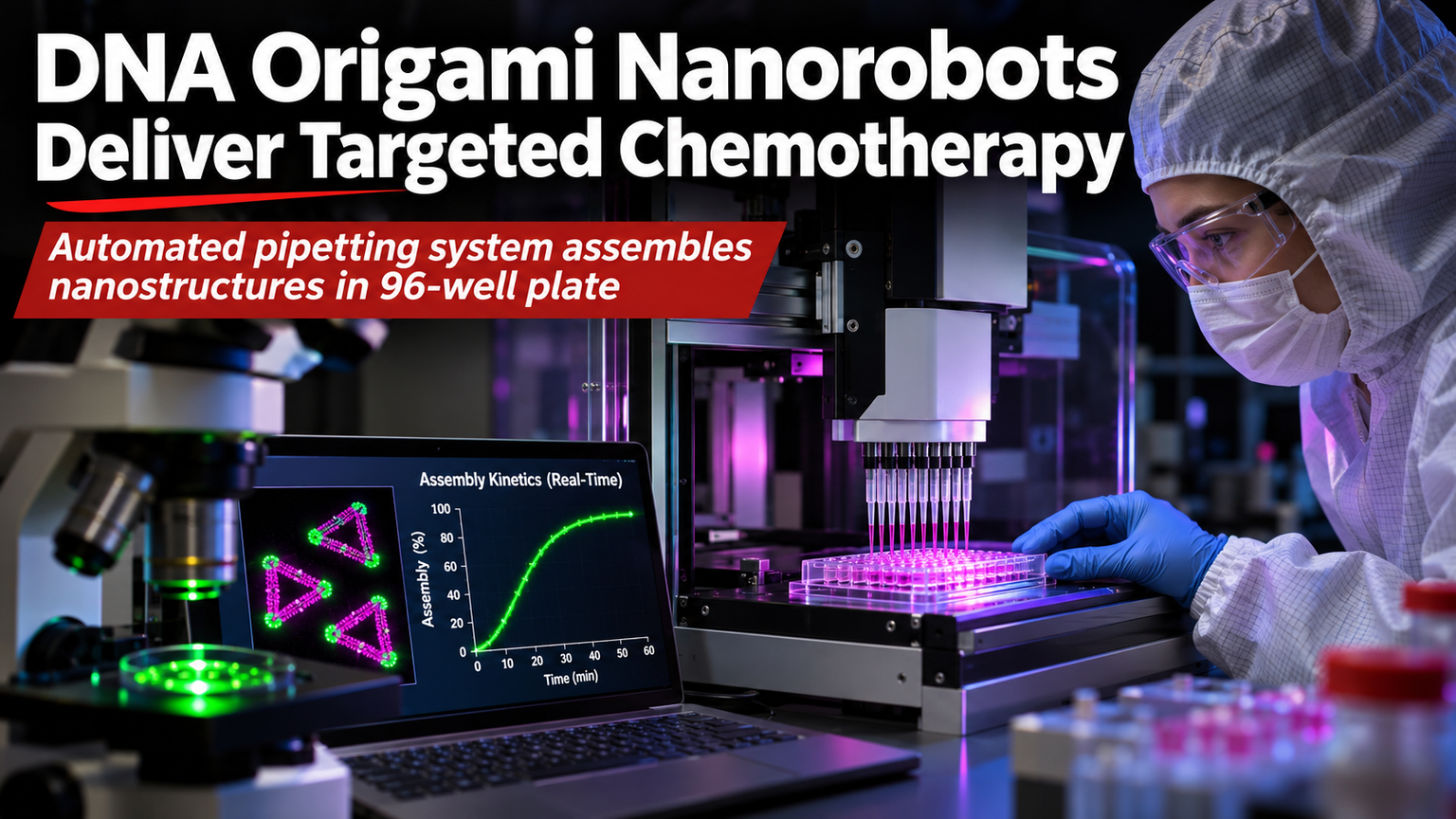
Imagine a microscopic surgeon, built not from steel but from the very code of life, navigating your bloodstream to deliver a lethal payload exclusively to cancer cells. This is not science fiction; it is the rapidly advancing reality of DNA origami nanorobots. By folding DNA strands into precise, programmable 3D shapes, researchers are creating autonomous molecular machines capable of targeted chemotherapy delivery, potentially ending the era of systemic toxicity.
The Blueprint: Molecular Programming with DNA Origami
DNA origami exploits the predictable base-pairing rules of nucleic acids (A-T, C-G) to fold a long "scaffold" strand into arbitrary shapes using hundreds of short "staple" strands. The result is a nanoscale chassis—often a hollow barrel, a tetrahedron, or a flat sheet—with addressable surfaces. Engineers attach functional moieties: aptamers for target recognition, drug intercalation sites for payloads, and logic gates for controlled release.
This programmable matter allows the robot to remain inert until it encounters a specific molecular signature—say, the co-expression of HER2 and MUC1 proteins on a breast cancer cell. Only then does the logic gate trigger a conformational change, opening the chassis to release the drug.
From Bench to In Vivo: Closing the Delivery Gap
Early prototypes proved the concept in cell culture, but physiological deployment introduced hurdles: nuclease degradation, renal clearance, and immune activation. Recent breakthroughs address these directly:
| Challenge | Engineering Solution | Status |
|---|---|---|
| Nuclease Degradation | PEGylation + 2'-Fluoro/2'-OMe modified nucleotides | In vivo half-life extended to >24h |
| Renal Clearance | Size tuning (>10nm) + Albumin-binding aptamers | Reduced kidney filtration |
| Immune Evasion | CpG motif depletion + CD47 "don't eat me" signals | Lower cytokine storm risk |
| Targeting Fidelity | Dual-aptamer AND gates + pH-sensitive latches | Single-cell specificity demonstrated |
"We are moving from static nanostructures to dynamic, computational devices that diagnose and treat at the single-molecule level.
— Shawn Douglas, PhD, UCSF
The Payload Problem: Loading and Release Kinetics
Loading efficiency remains a bottleneck. Intercalation (slipping planar drugs like Doxorubicin between base pairs) offers high density but slow release. Covalent conjugation via cleavable linkers (disulfide, hydrazone) offers triggerable release but lowers capacity. The current gold standard uses a hybrid approach: high-capacity intercalation for the bulk payload, gated by a stimuli-responsive DNA lock.
💡
TipOptimize loading by pre-incubating the scaffold with drug before staple addition; this traps molecules inside the folding structure, boosting encapsulation efficiency past 80%.
Clinical Trajectory and Regulatory Reality
No DNA nanorobot has yet reached Phase I trials for oncology. The FDA classifies these as combination products (device + biologic), requiring rigorous CMC (Chemistry, Manufacturing, Controls) characterization. Batch-to-batch structural fidelity, verified by cryo-EM and AFM, is non-negotiable. Scalability is shifting from thermal annealing (hours) to isothermal assembly and microfluidic continuous flow (minutes), bringing GMP manufacturing into view.
✦
Your Next Steps in Molecular Programming
The toolchain is maturing. If you are a computational biologist, a nanotech engineer, or a drug developer, the barrier to entry is lower than ever.
ℹ️
Note1. Design structures in **cadnano** or **vHelix**. 2. Simulate folding kinetics with **oxDNA** (coarse-grained MD). 3. Order staple pools from IDT or Twist (pool synthesis cuts cost 10x). 4. Validate folding via gel electrophoresis and negative-stain TEM before cryo-EM. 5. Functionalize with thiolated aptamers post-folding using maleimide chemistry.
The convergence of molecular biology, computer science, and pharmacology is producing a new therapeutic modality: software-defined medicine. The first approved DNA nanorobot will not just deliver a drug; it will execute a clinical decision algorithm inside the patient. Start building the logic today.