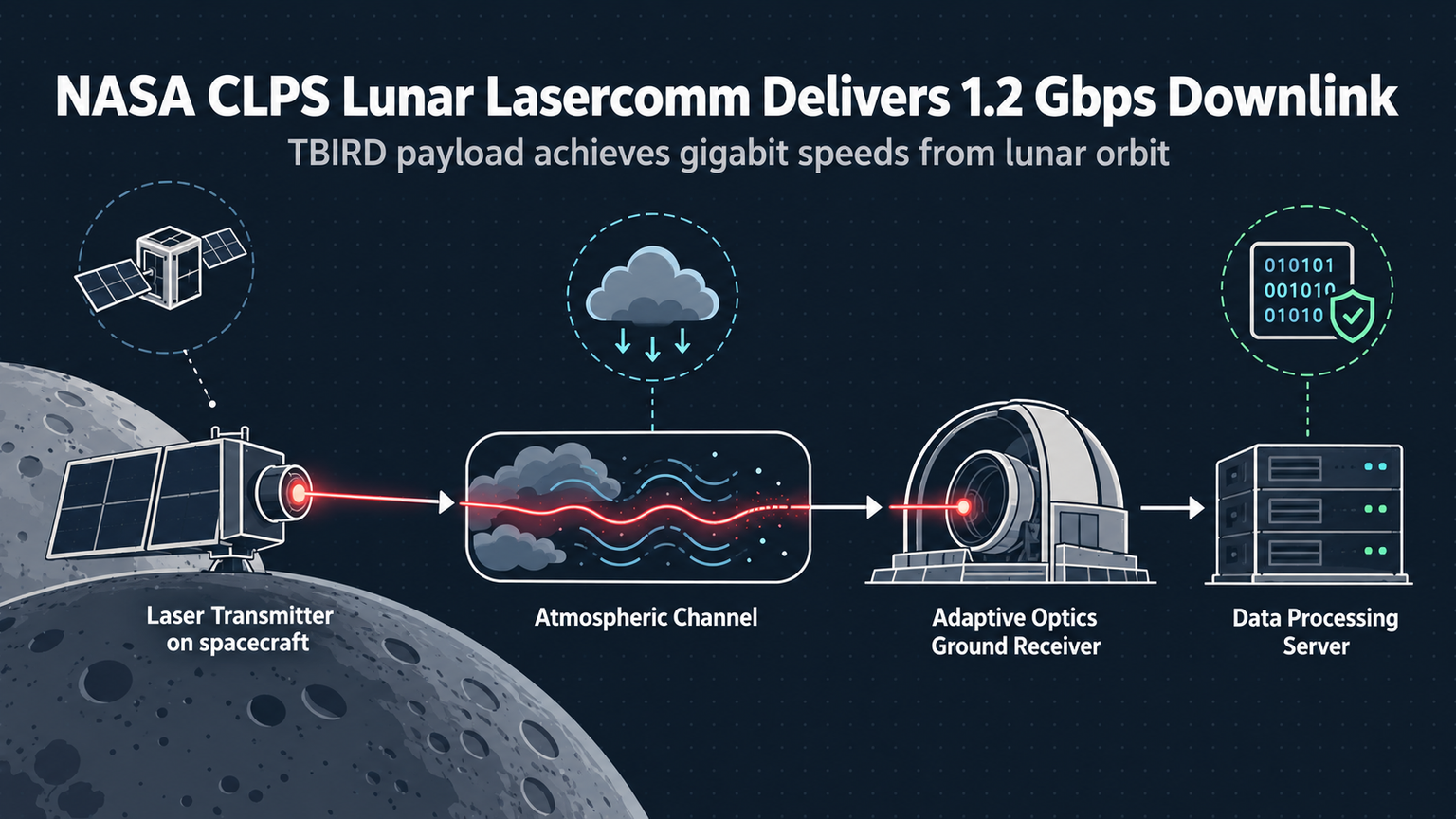
NASA's Commercial Lunar Payload Services program just proved that laser communications work on the Moon. The recent CLPS demonstration delivered a sustained 1.2 Gbps downlink from lunar orbit to Earth — a 100x improvement over traditional radio links. This isn't a lab experiment. It's operational hardware flying on a commercial lander, and it changes how we'll build the lunar internet.
Why Optical Beats Radio for Deep Space
Radio frequency spectrum is crowded, regulated, and physics-limited. Ka-band tops out around 100 Mbps from lunar distances with reasonable antenna sizes. Optical terminals use near-infrared lasers at 1550 nm, packing photons into a beam divergence measured in microradians. The result: gigabit rates with a terminal the size of a shoebox and a fraction of the power draw.
| Parameter | Ka-band Radio | Lasercomm (CLPS Demo) |
|---|---|---|
| Downlink Rate | ~100 Mbps | 1.2 Gbps |
| Terminal Mass | 15-25 kg | 3.2 kg |
| Power Consumption | 150-200 W | 45 W |
| Beam Divergence | 0.5-1 deg | 15 µrad |
| Aperture Size | 3-5 m (ground) | 1 m (ground) |
The Hardware: MIT Lincoln Lab's LLCD Heritage
The CLPS laser terminal traces directly to the Lunar Laser Communications Demonstration (LLCD) that flew on LADEE in 2013. That mission hit 622 Mbps down / 20 Mbps up from lunar orbit. The new terminal upgrades the modem, adds adaptive optics for atmospheric turbulence compensation, and integrates with the CLPS lander's command and data handling bus via SpaceWire. The optical head uses a 10 cm telescope with a fast steering mirror for fine pointing — critical when you're hitting a 1-meter ground station from 384,000 km away.