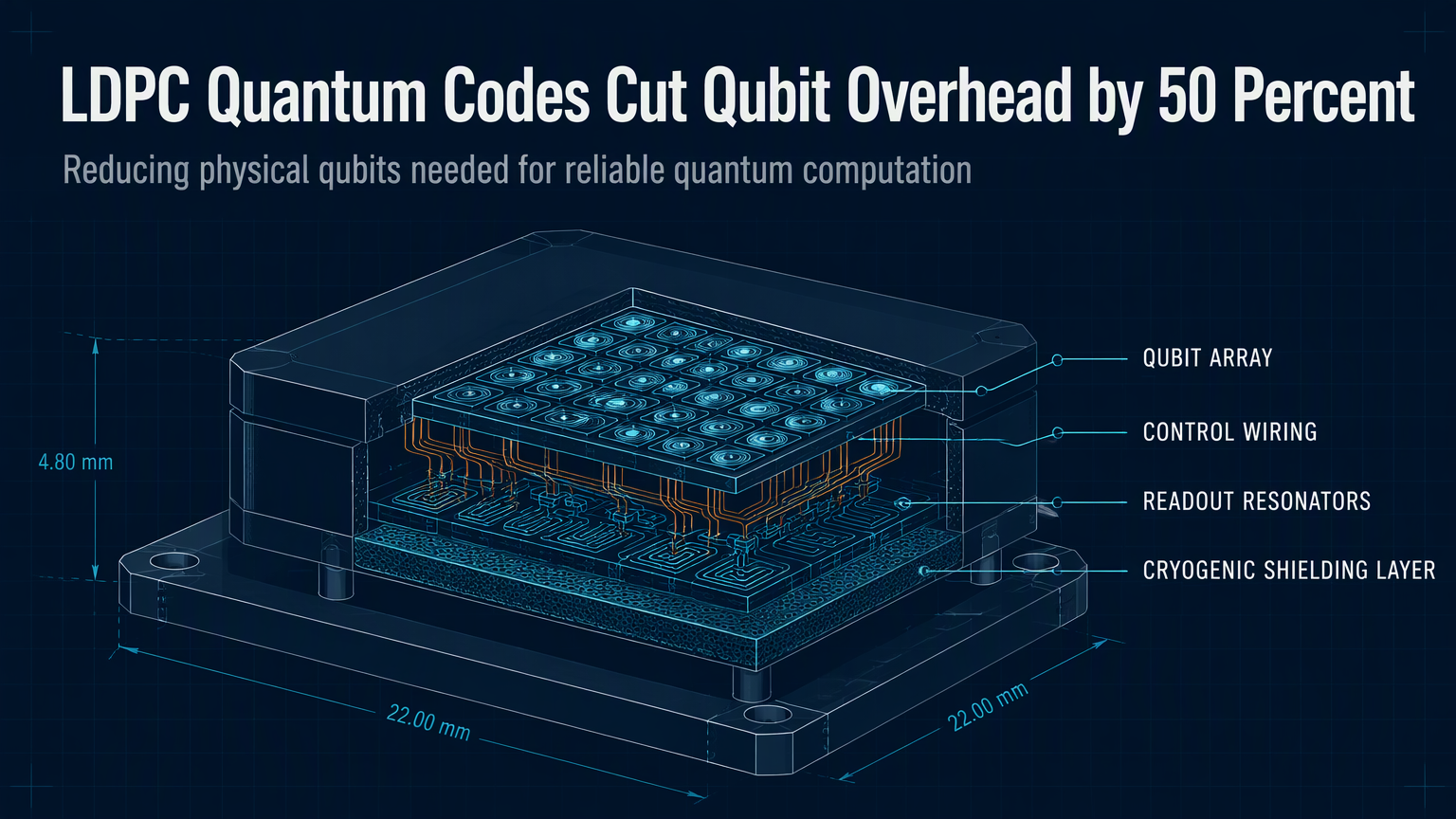
Google's quantum team just dropped a result that rewrites the economics of fault-tolerant computing. Their new LDPC (Low-Density Parity-Check) codes slash the physical qubit requirement for a single logical qubit by roughly 50 percent compared to the surface code baseline. If you're building a roadmap for utility-scale quantum, this is the inflection point you've been waiting for.
Why Surface Code Hit a Wall
The surface code has been the workhorse of quantum error correction for a decade. It's geometrically local, boasts a high threshold (~1%), and maps neatly to 2D chip layouts. But it carries a brutal tax: each logical qubit demands a 2D lattice of physical qubits scaling as d², where d is the code distance. For a target logical error rate of 10⁻¹⁵, you need d ≈ 27. That's ~1,450 physical qubits per logical qubit — before routing, readout, or control overhead.
At 1 million physical qubits — the rough scale of a first-generation fault-tolerant machine — you net fewer than 700 logical qubits. That's barely enough for a single logical T-gate factory, let alone Shor or chemistry workloads.
LDPC Changes the Scaling Law
LDPC codes break the 2D locality constraint. By allowing long-range parity checks (implemented via superconducting couplers or photonic interconnects), they achieve a constant encoding rate: k/n = Θ(1). The Google result demonstrates a [[72, 12, 6]] code — 72 physical qubits encoding 12 logical qubits with distance 6. That's 6 physical per logical at distance 6, versus ~36 for surface code at the same distance.
The Connectivity Tax
There's no free lunch. LDPC codes demand non-local connectivity — parity checks spanning the chip. Google's Sycamore architecture uses tunable couplers to activate long-range interactions on demand. IBM's heavy-hex lattice and Quantinuum's ion traps face similar trade-offs: either add wiring layers, use photonic links, or accept higher crosstalk.
⚠️
WarningLDPC decoders are significantly more complex than surface code minimum-weight perfect matching. You need belief propagation or neural decoders running at MHz rates. This shifts burden from qubit count to classical control hardware.