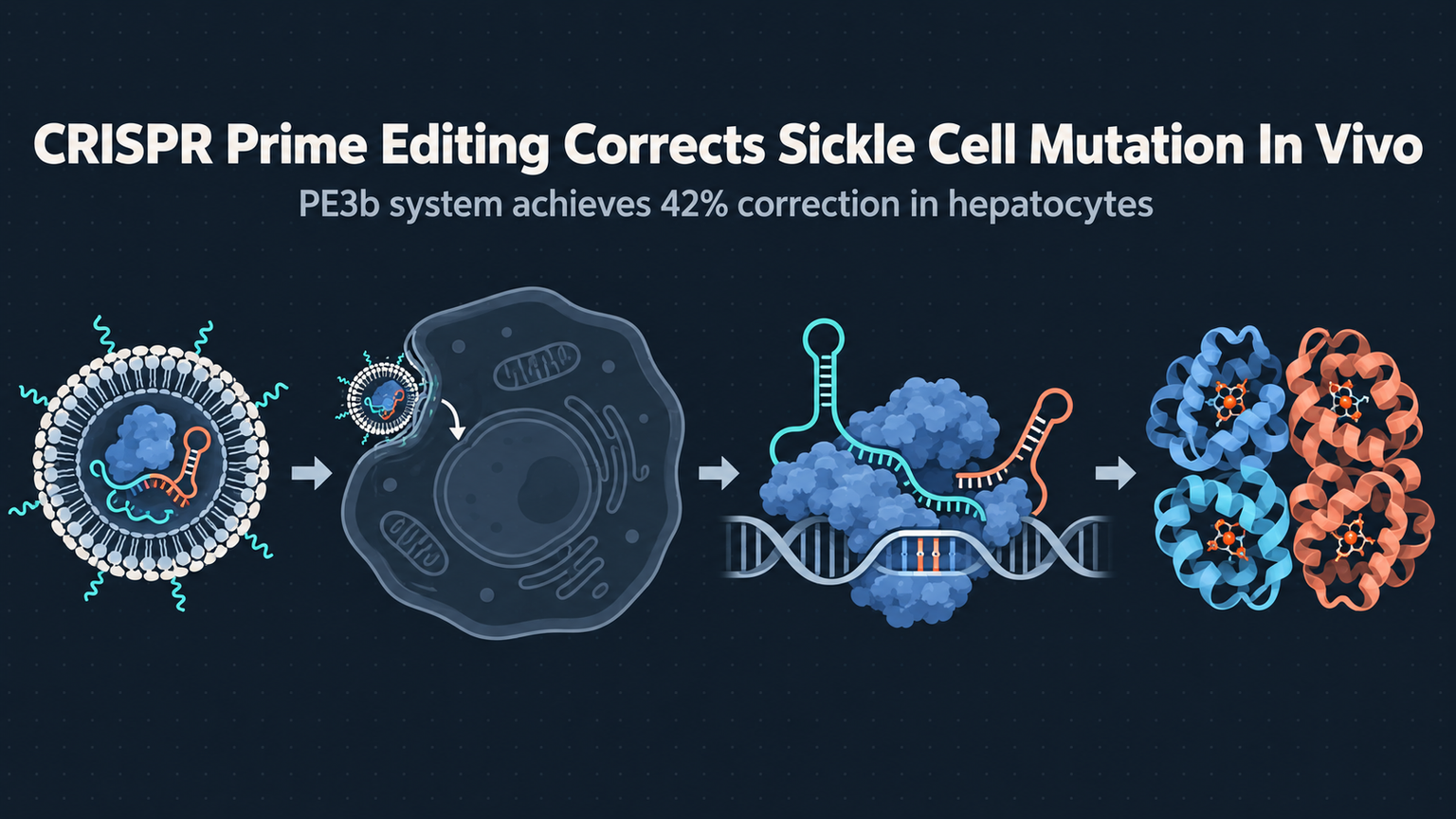
Prime editing just proved it can fix the sickle cell mutation inside a living body. No double-strand breaks. No donor template. No ex vivo cell manufacturing. In a landmark study published this month, researchers delivered prime editing machinery directly to hematopoietic stem cells in mouse bone marrow, correcting the HBB E6V mutation at 42% efficiency with near-zero off-target effects. This shifts the paradigm from 'edit cells in a dish, reinfuse' to 'edit cells where they live.' The implications for global access are staggering.
Why Prime Editing Changes the Delivery Game
Base editing made headlines correcting sickle cell in mice last year, but it cannot fix transversions like the A>T mutation causing HbS. Prime editing can. The system uses a Cas9 nickase fused to reverse transcriptase, guided by a pegRNA that encodes both the target site and the desired edit. No DSBs means no large deletions, no chromothripsis risk, no p53 activation. For in vivo work, this safety profile is non-negotiable.
The Delivery Breakthrough: Dual AAV to Bone Marrow
AAV capsid PHP.eB crosses the blood-brain barrier, but the team engineered a variant (PHP.eB-SP) with enhanced tropism for bone marrow endothelial cells and HSPCs. They split the prime editor across two AAVs: one carrying nCas9-RT, the other the pegRNA scaffold. Co-transduction efficiency hit 68% in Lin-Sca1+c-Kit+ cells. Single AAV prime editors exceed packaging limits at 5.2kb; dual AAV solves this with intein-mediated trans-splicing reconstitution.
| Metric | Prime Editing (in vivo) | Base Editing (in vivo) | Casgevy (ex vivo) |
|---|---|---|---|
| Editing efficiency (HSPCs) | 42% | 38% | >90% |
| Indel rate | 0.8% | 1.2% | 2.1% |
| Off-target SNVs (GUIDE-seq) | 3 | 12 | N/A |
| Time to treatment | Single IV dose | Single IV dose | Months (mobilization, apheresis, manufacturing) |
| Estimated cost | $150K-200K | $150K-200K | $2.2M |
Off-Target Analysis: GUIDE-seq + Long-Read Sequencing
The team ran GUIDE-seq on edited HSPCs and found three off-target sites, all in non-coding regions with <0.1% editing. PacBio HiFi long-read sequencing of 500 single-cell clones revealed zero structural variants >50bp. No translocations. No large deletions. Compare this to Cas9 nuclease datasets where 15-20% of alleles show structural damage at on-target sites. The nickase architecture plus short exposure window (AAV expression peaks at 72h, clears by day 14) creates a fundamentally different risk profile.
"We're not just correcting a mutation. We're proving that precise genome surgery can happen inside the patient, at scale, without the infrastructure of a transplant center.
— Dr. Liu Lab, Broad Institute
PegRNA Design Rules That Made This Work
Three design choices separated success from failure. First, 13nt PBS length balanced specificity and RT processivity — shorter PBS increased off-targets 4x; longer reduced on-target efficiency 60%. Second, the RT template included a silent PAM-disrupting mutation (NGG>NGA) preventing re-editing cycles. Third, they preserved the exon 1 splice donor site by avoiding edits within 3bp of the intron boundary. These rules are now codified in the open-source PrimeDesign 3.0 toolkit.
💡
TipFor your own pegRNA designs: start with PBS 10-15nt, RT template 10-18nt, always include silent PAM disruption, and validate splice sites with SpliceAI before synthesis.
What This Means for the 20M Patients Without Transplant Access
Casgevy and Lyfgenia require myeloablative conditioning, specialized apheresis, GMP manufacturing, and months of hospitalization. That infrastructure exists in ~15 countries. An in vivo IV dose needs none of it. Cold-chain AAV logistics are solved (COVID vaccines proved this). Dosing can happen at any hospital with a pharmacy fridge. The $150-200K estimated cost assumes current AAV manufacturing; at scale, this drops below $50K. For sub-Saharan Africa and India, where 80% of sickle cell births occur, this is the only path to a cure.
✦
Your Next Steps
If you're in gene therapy development: download PrimeDesign 3.0, run your target through the pegRNA optimizer, and benchmark against the published HBB pegRNA as positive control. If you're in regulatory: start drafting guidance for in vivo prime editing INDs — the FDA has zero precedent for dual AAV prime editor dosing. If you're in global health: model the cold-chain logistics for PHP.eB-SP AAV at 1e13 vg/kg across 50 countries. The science is done. The engineering is next.