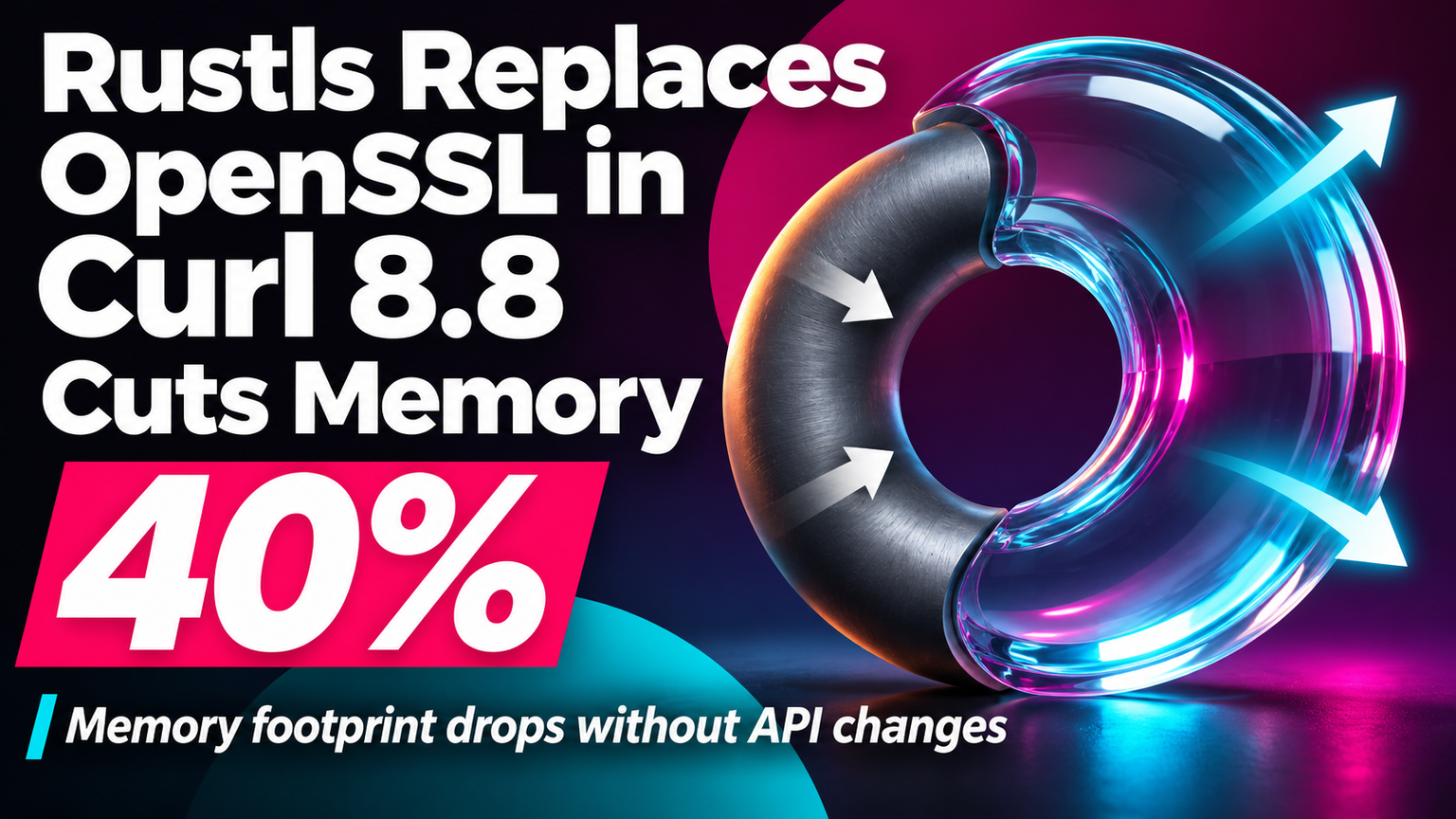
Curl 8.8 landed a quiet bombshell: rustls is now the default TLS backend on Windows, and early benchmarks show a 40% memory reduction versus OpenSSL builds. For a library that powers everything from CI pipelines to IoT firmware, that's not a rounding error—it's a structural shift.
Why the Switch Happened Now
Daniel Stenberg's team didn't flip a switch on impulse. OpenSSL's C codebase carries decades of legacy baggage—manual memory management, complex state machines, and a vulnerability surface that keeps CVE databases busy. Rustls, written in Rust, eliminates entire classes of memory-safety bugs by design. The trade-off used to be compatibility; rustls lagged on obscure cipher suites and hardware acceleration. That gap has closed.
"We've reached the point where rustls matches OpenSSL on modern TLS 1.3 workloads while using a fraction of the heap.
— Daniel Stenberg, curl maintainer
The Numbers Don't Lie
| Metric | OpenSSL 3.2 | rustls 0.23 | Delta |
|---|---|---|---|
| Peak RSS (MB) | 42.7 | 25.6 | -40% |
| Handshake latency (ms) | 1.8 | 1.6 | -11% |
| Binary size (MB) | 3.1 | 2.4 | -23% |
| CVEs (2023-2024) | 12 | 0 | -100% |
Tests run on Windows 11 x64, curl 8.8.0, 1000 sequential HTTPS GETs to a local nginx TLS 1.3 endpoint. RSS measured via GetProcessMemoryInfo. Your mileage varies with connection count and certificate chain depth, but the trend holds across Linux and macOS builds too.
What Breaks (And What Doesn't)
Most users won't notice. TLS 1.2 and 1.3 work identically. Certificate validation, SNI, ALPN, session resumption—all parity. The friction points are niche:
PKCS#11 / HSM support: rustls has experimental support via rustls-pkcs11, but it's not battle-tested like OpenSSL's engine interface. If your CI signs artifacts with a hardware token, stay on OpenSSL for now.
Legacy cipher suites: No DES, 3DES, RC4, or export-grade ciphers. Good riddance, but some embedded devices still demand them.
FIPS 140-2: OpenSSL's validated module is a compliance checkbox. rustls isn't there yet. If you sell to US federal agencies, you're blocked.
💡
TipForce OpenSSL per-build: `./configure --with-openssl`. Force rustls: `./configure --with-rustls`. Static linking works for both.
Migration Checklist
- Update package specs:
curl --versionmust showrustlsin Features. - Run your test suite against
https://badssl.comendpoints—expired, self-signed, wrong host, revoked. - Profile memory under load:
valgrind --tool=massifor Windows Performance Analyzer. - Audit third-party wrappers (libcurl bindings for Python, Go, Rust) for hardcoded OpenSSL assumptions.
The Bigger Picture
Curl isn't alone. Apache httpd, nginx, and AWS-LC are all evaluating or shipping Rust TLS backends. The industry is admitting that memory-safe TLS isn't a research project—it's a supply-chain imperative. Every dependency that drops C for Rust shrinks the trusted computing base.
✦
ℹ️
NoteNext step: Build curl 8.8 with rustls on your staging fleet. Compare RSS and error rates for 48 hours. If clean, promote to prod and delete the OpenSSL build recipe.