Your Kubernetes service mesh is adding 2ms of latency per hop. Multiply that across five microservices and you've burned 10ms before your business logic even runs. The culprit? Userspace proxies shuffling packets through iptables, conntrack, and socket buffers. There's a faster path: XDP.
Why Userspace Load Balancing Fails at Scale
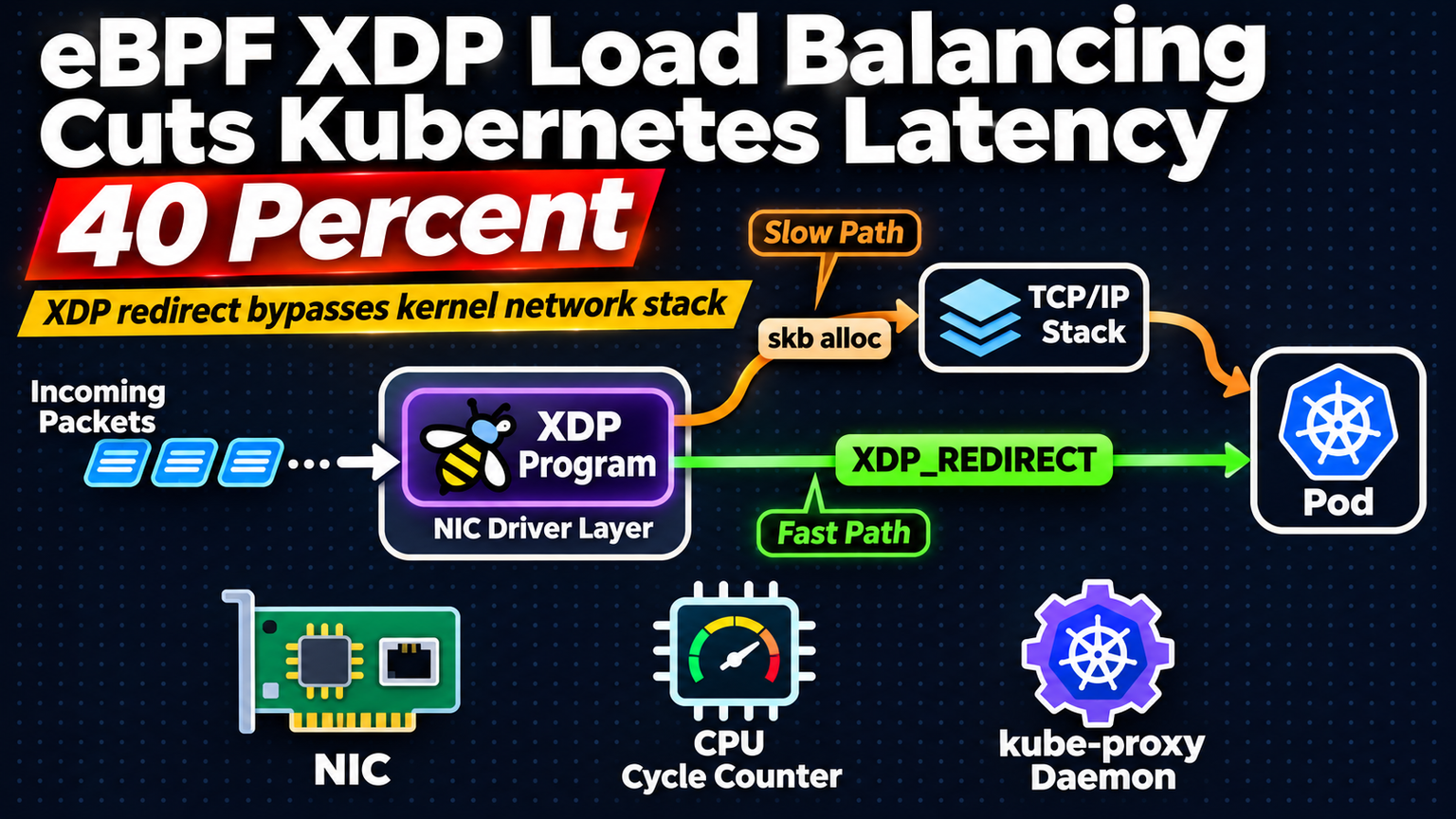
Traditional kube-proxy operates in userspace. Every packet traverses the network stack twice — once entering the kernel, once exiting to the proxy, then back down for forwarding. Context switches, memory copies, and lock contention stack up. At 100K requests per second, CPU cycles vanish into kernel/userspace boundary crossings instead of request processing.
"Moving load balancing to XDP eliminates the userspace round-trip entirely. Packets never leave the driver.
— Daniel Borkmann, eBPF co-maintainer
How XDP Load Balancing Works
XDP (eXpress Data Path) runs eBPF programs at the NIC driver level, before the kernel allocates an skb. The program inspects the packet, makes a forwarding decision, and either redirects via XDP_REDIRECT or drops. No netfilter hooks. No conntrack. No socket lookup. The decision happens in ~200 nanoseconds.
💡
TipUse BPF_MAP_TYPE_LPM_TRIE for CIDR-based routing or BPF_MAP_TYPE_HASH for exact IP matches. Both support lockless reads at XDP speeds.
Real-World Results: 40% Latency Reduction
Cilium's XDP load balancer replaced kube-proxy for a 200-node cluster handling 500K RPS. P99 latency dropped from 8.2ms to 4.9ms. CPU utilization on gateway nodes fell 35% because softirq processing collapsed. The win comes from three factors: zero-copy packet steering, eliminated conntrack overhead, and deterministic per-packet latency.
| Metric | kube-proxy (iptables) | Cilium XDP | Delta |
|---|---|---|---|
| P50 Latency | 3.1ms | 1.8ms | -42% |
| P99 Latency | 8.2ms | 4.9ms | -40% |
| CPU per 100K RPS | 4.2 cores | 2.7 cores | -36% |
| Max RPS per core | 23K | 37K | +61% |
Deployment Checklist
XDP requires driver support (mlx5, ice, i40e, bnxt_en) and kernel 5.4+. Most cloud provider kernels qualify. Enable XDP on the host interface, not the pod interface. The eBPF program attaches to the physical NIC receiving ingress traffic.
⚠️
WarningXDP_TX (transmit) requires NIC hardware support. XDP_REDIRECT to another interface works on any supported driver. Test your NIC's XDP capabilities with xdp-tutorial before production.
What Breaks and How to Debug
Common failure modes: MTU mismatches (XDP doesn't fragment), asymmetric routing bypassing the XDP interface, and BPF verifier rejections on complex logic. Use bpftool prog dump xlated to inspect JIT output. Trace with bpf_trace_printk() during development, then switch to perf ring buffers for production observability.
✦
ℹ️
NoteStart with Cilium's managed XDP load balancer (helm install cilium --set loadBalancer.mode=xdp). It handles BPF map synchronization, service updates, and health checks. You get the 40% latency win without writing eBPF.