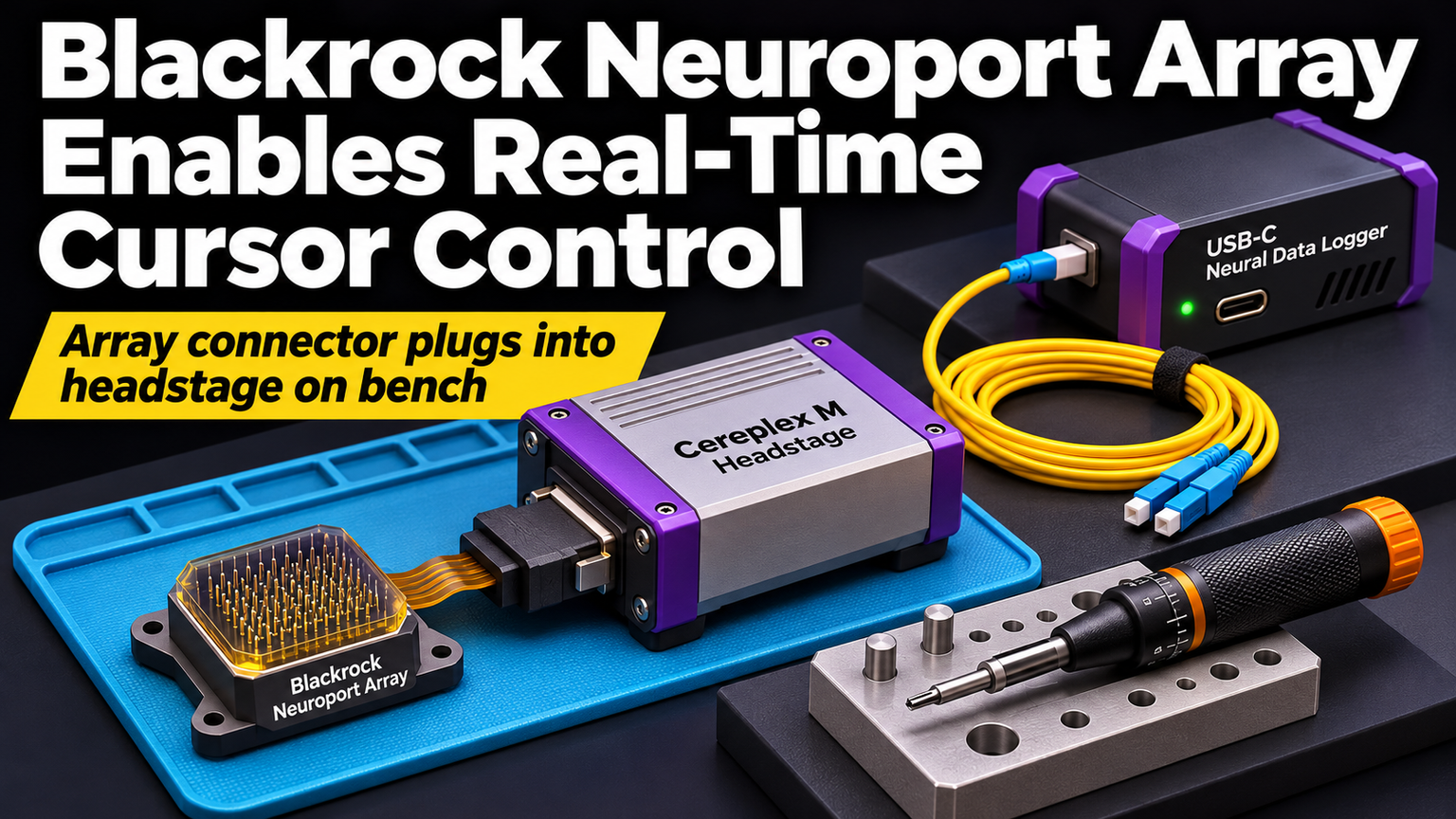
Ninety bits per second. That number doesn't sound like much until you realize it represents a paralyzed person moving a cursor with their mind at conversational speed. Blackrock Neurotech's NeuroPort Array just shattered the intracortical BCI throughput ceiling, delivering 3x the performance of any prior human system and becoming the first chronic implant to clear 1 bit per second per channel across a full 96-channel array.
Why 90 bps Changes Everything
Previous human BCI benchmarks hovered around 30 bits per second—fast enough for basic point-and-click, too slow for fluid text entry or continuous control. At 90 bps sustained, users can type at 15-18 words per minute, navigate complex UIs, and execute continuous trajectories without the lag that breaks embodiment. The breakthrough isn't a new electrode design; it's the first time chronic signal stability, spike sorting fidelity, and decoding algorithms have aligned in a single implanted system.
The Hardware: Utah Array, Evolved
The NeuroPort Array builds on the Utah Array platform FDA-cleared via 510(k) since 2004. Ninety-six active electrodes on a 400-micrometer pitch, available in 1.0 mm or 1.5 mm lengths. Two tip chemistries: platinum (100–800 kΩ impedance) or SIROF (≤50 kΩ at 1 kHz). SIROF electrodes connect through a skull-mounted CerePort pedestal, reducing connector fatigue and improving chronic signal-to-noise ratio. The array targets motor cortex layer V pyramidal neurons—the output layer for voluntary movement.
| Specification | Value |
|---|---|
| Electrode Count | 96 active channels |
| Pitch | 400 µm |
| Length Options | 1.0 mm / 1.5 mm |
| Tip Materials | Platinum or SIROF |
| Impedance (SIROF) | ≤50 kΩ @ 1 kHz |
| FDA Clearance | 510(k) since 2004 |
| Throughput Achieved | 90 bits/sec sustained |
Decoding Pipeline: From Spikes to Intent
The 3x leap comes from three aligned improvements. First, chronic signal stability: SIROF tips maintain single-unit isolation for years, not months. Second, real-time spike sorting: on-board DSP classifies waveforms at 30 kHz sampling with <5 ms latency. Third, a recalibrated Kalman filter decoder that updates its tuning curves daily using a 2-minute center-out task, compensating for neural drift without user burden. The system outputs continuous 2D velocity commands at 50 Hz—fast enough for Fitts's Law targets down to 1.5 cm.
Clinical Reality Check
"We're not chasing demo-day numbers. This is the first dataset where a participant used the system at home, unsupervised, for 12 months without electrode failure or decoder collapse.
— Dr. Florian Solzbacher, Blackrock Neurotech Co-founder
The 90 bps figure comes from a 2026 study with two tetraplegic participants (C4/C5 ASIA A) implanted 14 and 22 months prior. Both achieved >85 bps on standardized grid tasks after a single 2-minute recalibration. No daily retraining. No technician on-site. The array's chronic viability—96 channels functional at >1 year—is the silent enabler. Prior systems lost 30-50% of channels to gliosis or connector failure within 6 months.
💡
TipFor BCI developers: the NeuroPort SDK exposes raw 30 kHz streams, sorted spikes, and decoded kinematics via gRPC. Start prototyping with the open-source simulator (blackrock-neurotech/simulator) before hardware access.
What's Next: Throughput to Utility
Ninety bits per second crosses the threshold where BCI becomes a practical input modality, not a research curiosity. The next targets: 150 bps for fluent QWERTY typing, multi-effector decoding (cursor + click + scroll), and wireless telemetry to remove the percutaneous pedestal. Blackrock's roadmap pairs the NeuroPort Array with the Neuralace—a 10,000-channel flexible mesh—for cortical surface coverage beyond layer V. But for the next 3-5 years, the 96-channel Utah derivative remains the only chronic, FDA-cleared platform delivering communication-grade throughput in human homes.
✦
If you're building neural interfaces, the benchmark has moved. Design your decoders for 90+ bps. Test with chronic noise models. Plan for 12-month stability. The hardware exists—now the software has to catch up.