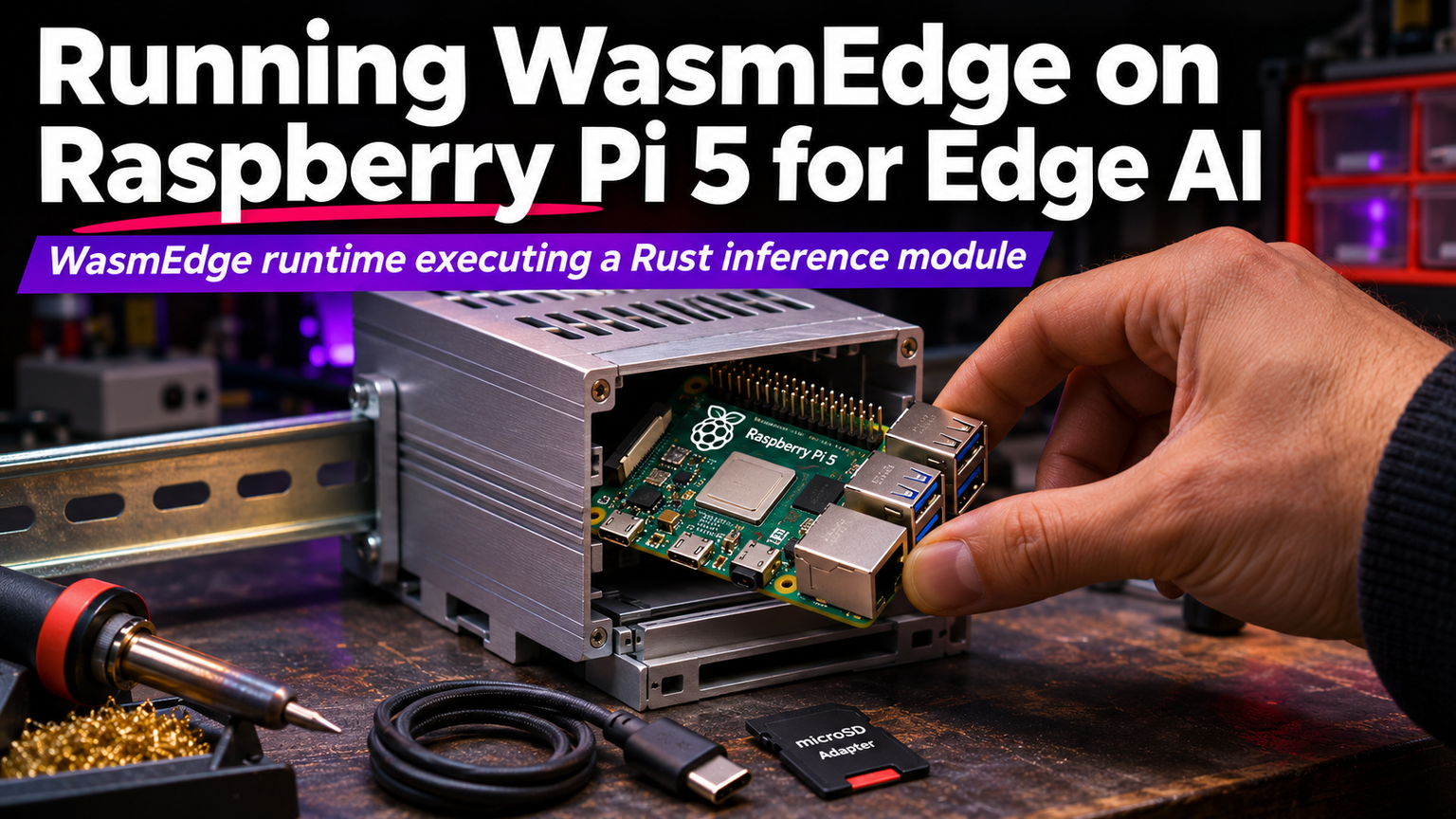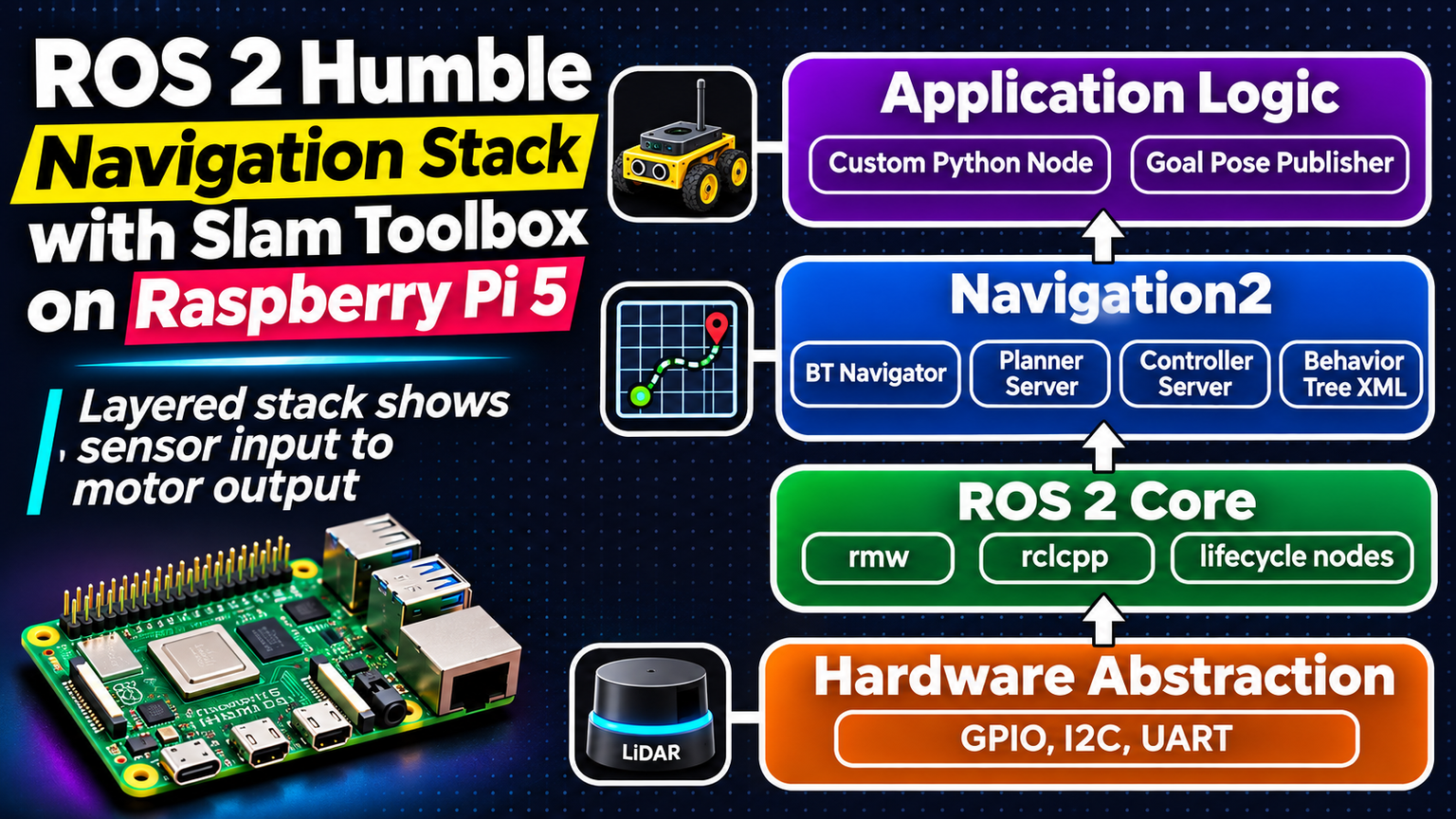
The Raspberry Pi 5 changed the economics of mobile robotics. For the first time, a $80 single-board computer delivers enough CPU cycles to run a full ROS 2 Humble navigation stack—SLAM, localization, and path planning—without offloading to a laptop. I spent three weeks tuning Slam Toolbox and Nav2 on a Pi 5 driving a differential-drive base. Here is the minimal viable path from a fresh OS image to autonomous waypoint following.
Hardware Baseline
| Component | Spec |
|---|---|
| SBC | Raspberry Pi 5 8 GB |
| Storage | 256 GB NVMe via Pimoroni NVMe Base |
| Lidar | RPLidar A1M8 (USB) |
| MCU | STM32F4 running micro-ROS |
| Battery | 2S 5000 mAh LiPo + 5 V 5 A UBEC |
Active cooling is non-negotiable. The Pi 5 throttles at 80 °C; the official active cooler keeps sustained compiles under 65 °C. Mount the Lidar high enough to clear the chassis lip—0.2 m is the practical minimum for 270° FOV.
OS and ROS 2 Install
💡
TipUse the NVMe boot path. SD cards cannot sustain the write throughput of SLAM map serialization.
Slam Toolbox Configuration
Slam Toolbox replaces the legacy gmapping/Cartographer combo with a single, maintenance-mode codebase. The async solver keeps the Pi’s four Cortex-A76 cores fed without starving the control loop.
⚠️
WarningSet <code>minimum_time_interval: 0.5</code>. The default 0.1 floods the CPU with scan matching threads and starves Nav2.
Nav2 Parameter Tuning for Pi 5
Nav2 defaults assume a desktop GPU. On the Pi 5 you must shrink the costmap footprint, reduce planner frequency, and disable unused plugins.
ℹ️
NoteRegulated Pure Pursuit is lighter than DWB and handles differential-drive kinematics natively.
Bringup and First Map
Drive slowly. Fast rotations induce motion blur on the A1M8 and break scan matching. After 2–3 minutes save the map: ros2 run nav2_map_server map_saver_cli -f my_map.
Autonomous Waypoint Test
Switch to full navigation bringup. Send a goal via RViz2 or the action client:
Performance Numbers
| Metric | Value |
|---|---|
| CPU (mapping) | 65 % across 4 cores |
| CPU (nav only) | 38 % |
| RAM usage | 1.2 GB / 8 GB |
| Map serialization | 1.4 s (50 m²) |
| Replan latency | 120 ms avg |
✦
Clone the reference repo, flash the NVMe, and you have a repeatable baseline. From here: add AMCL tuning for kidnap recovery, integrate a depth camera for obstacle avoidance, or swap the planner for Smac Hybrid-A* if you need reverse maneuvers. The Pi 5 finally makes “laptop-free” a shipping feature, not a demo trick.
💡
TipPin the ROS 2 apt repository to Humble. Rolling upgrades mid-project break ABI compatibility between Slam Toolbox and Nav2.