For decades, lunar missions operated in isolation. Each lander carried its own antenna, its own clock, its own fragile link to Earth. A rover on the far side waited hours for a command cycle. An astronaut on EVA had no real-time telemetry. That era ends now.
The Convergence
ESA's Moonlight and NASA's LunaNet are merging into a single interoperable backbone. Not a handshake agreement—shared protocols, shared frequencies, shared timing. The Lunar Communications and Navigation Services (LCNS) specification, finalized in late 2025, defines how any certified asset—orbiter, lander, rover, suit—joins the network without custom integration.
"We stopped building radios and started building a network. The difference is the difference between a walkie-talkie and the internet.
— Javier Ventura-Traveset, ESA Moonlight Navigation Manager
Architecture: 5 Satellites, One Standard
The first Moonlight constellation launches 2026: four navigation satellites in elliptical frozen orbits (12-hour period, 86° inclination) plus one high-data-rate comms relay in a near-rectilinear halo orbit. Together they cover the south pole—Artemis base camp territory—with 99.9% availability and sub-10-meter positioning.
| Parameter | Value |
|---|---|
| Navigation satellites | 4 (elliptical frozen orbits) |
| Comms relay | 1 (NRHO) |
| Positioning accuracy | < 10 m (3D) |
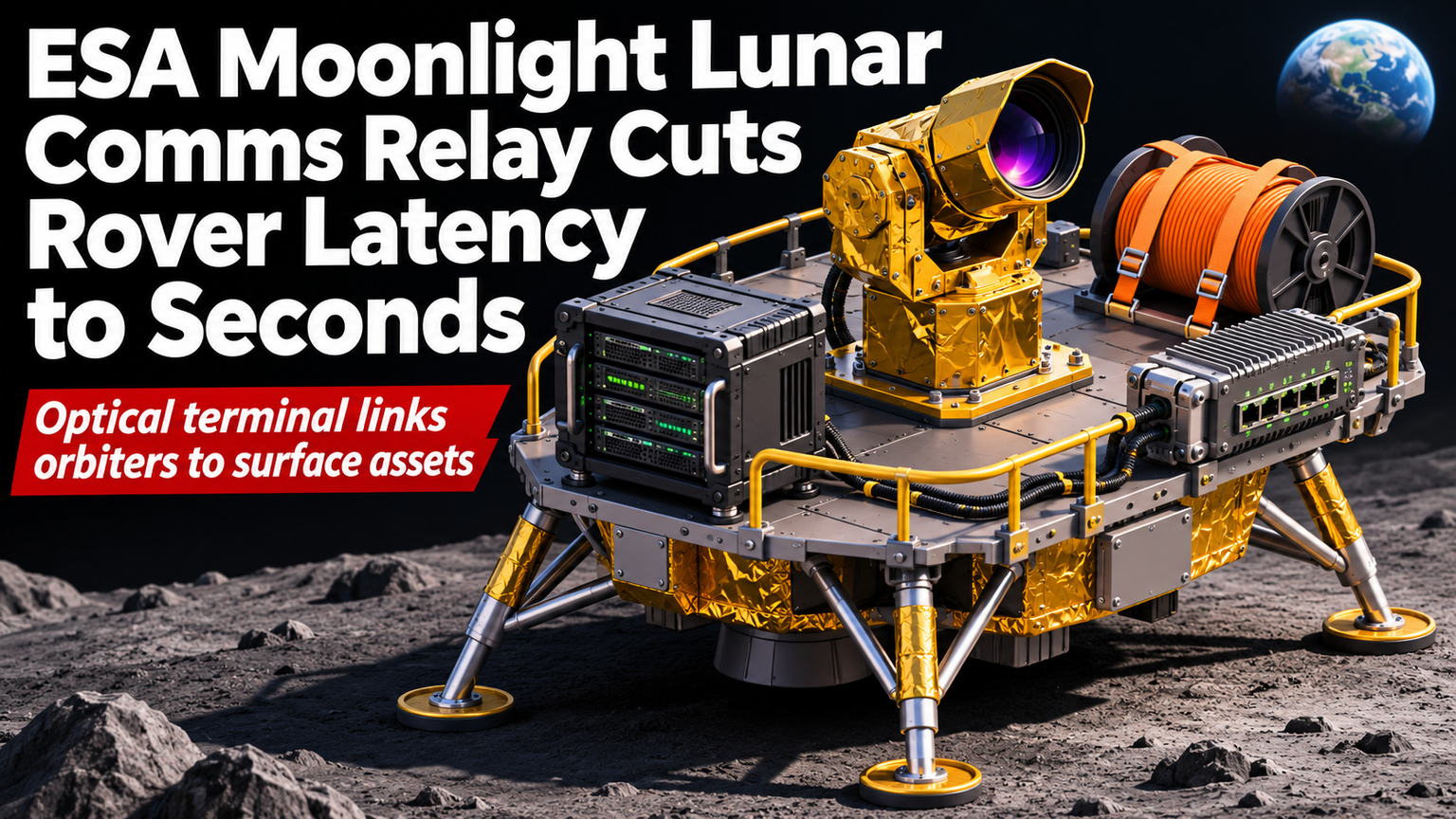
| Return link latency | < 2 s (surface to Earth) |
| Forward link data rate | Up to 1 Gbps |
| Return link data rate | Up to 500 Mbps |
| Timing accuracy | < 20 ns UTC traceable |
| Interoperability | LunaNet/LCNS v1.0 compliant |
From Delay-Tolerant to Real-Time
Legacy lunar ops relied on Delay/Disruption Tolerant Networking (DTN)—store-and-forward bundles that could sit for orbits. Moonlight replaces DTN for critical paths with a hybrid: DTN for bulk science, TCP/IP over L-band/S-band/Ka-band for teleoperations. The result: a rover operator in Houston sees stereo video at 2-second round-trip. That’s telepresence, not telemetry.