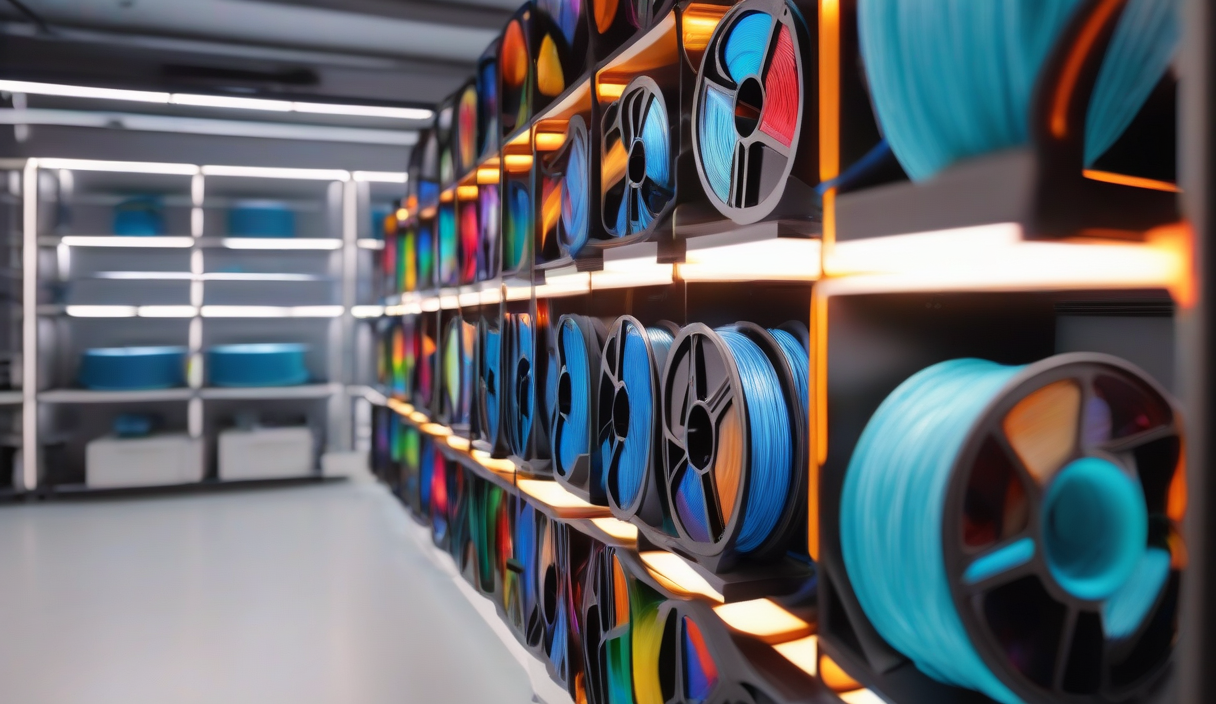
Here is the hard truth the 3D printing industry does not say loudly enough: in 2024, filament quality matters more than the printer itself. The hardware race has largely been won — modern machines from Bambu Lab, Prusa, and Creality are genuinely excellent. The variable that now separates a frustrating hobby from a reliable workflow is the spool sitting on your holder.
The Big Five Filaments Compared
| Material | Best For | Print Temp (°C) | Bed Temp (°C) | Difficulty | Key Weakness |
|---|---|---|---|---|---|
| PLA | Prototypes, decor, low-stress parts | 190-220 | 50-60 | Beginner | Low heat resistance (60°C) |
| PETG | Functional parts, outdoor, food-safe | 230-250 | 70-85 | Intermediate | Stringing, bridging issues |
| ABS/ASA | Enclosures, automotive, high heat | 240-270 | 90-110 | Advanced | Warping, fumes, needs enclosure |
| TPU | Gaskets, phone cases, wearables | 210-230 | 40-60 | Advanced | Slow print speed, stringing |
| Nylon/CF | Gears, structural, high strength | 250-290 | 70-100 | Expert | Hygroscopic, abrasive, needs hardened nozzle |
💡
TipBuy filament from brands that publish batch-specific QC data (diameter tolerance ±0.02mm, ovality <0.01mm). Polymaker, Prusament, Bambu Lab, and Atomic Filament lead here. Avoid generic Amazon brands for critical prints.
Drying and Storage: The Silent Print Killers
Moisture is the number one cause of poor layer adhesion, bubbling, and brittle prints. PLA absorbs less water than PETG or Nylon, but every hygroscopic filament degrades after 48 hours in open air. A $40 filament dryer (Sunlu S2, Creality Space Pi) pays for itself in saved spools within a month. Store active spools in airtight bins with rechargeable silica gel; keep bulk stock in vacuum-sealed bags with humidity indicators.
Printer Recommendations by Use Case
| Category | Top Pick | Runner-Up | Why It Wins |
|---|---|---|---|
| Beginner Plug-and-Play | Bambu Lab A1 Mini | Creality Ender 3 V3 KE | AMS Lite multi-material, auto-calibration, 5-min setup |
| Enthusiast Workhorse | Prusa MK4 | Bambu Lab X1C | Open ecosystem, rock-solid support, 5-year warranty |
| High-Temp/Engineering | Bambu Lab X1C + Hardened Nozzle | Raise3D Pro3 | Actively heated chamber (60°C), vibration compensation |
| Budget King | Creality Ender 3 V3 SE | Anycubic Kobra 2 | Direct drive, auto-leveling, <$200 |
| Resin (MSLA) | Elegoo Saturn 4 Ultra | Phrozen Sonic Mini 8K | 10" 12K screen, auto-resin feed, heated vat |
"The best printer is the one you don't have to think about. Reliability compounds; tinkering subtracts.
— Josef Prusa
Slicer Settings That Actually Move the Needle
Stop chasing magic profiles. Master these four levers instead: 1) Flow calibration — print a single-wall cube, measure wall thickness, adjust flow until it matches line width. 2) Pressure advance / Linear advance — tune per filament to eliminate blobbing at corners. 3) Temperature towers — run one per new spool; optimal temp often differs 5-10°C from box specs. 4) Retraction — test with a stringing tower; direct drive needs 0.8-1.5mm, Bowden 3-5mm. Save tuned profiles per filament brand, not just material type.
⚠️
WarningCarbon fiber and glow-in-the-dark filaments destroy brass nozzles in 200-300g. Upgrade to hardened steel or obxidian nozzles before loading. Factor nozzle cost into filament price per kg.
Specialty Filaments: When to Splurge
ASA beats ABS for outdoor use — UV resistance without the warping headache. PC (Polycarbonate) demands 300°C+ hotend and 60°C chamber; unmatched impact strength for drone arms. PP (Polypropylene) lives hinges and chemical tanks but warps violently — needs PEI sheet and glue stick. Support-specific filaments (BVOH, PVA) dissolve in water; essential for complex internal geometries but cost 3-4x standard filament. Silk PLA hides layer lines beautifully for display models but sacrifices layer adhesion — never use for structural parts.
✦
ℹ️
NoteAction plan: 1) Audit your filament stash — toss anything opened >6 months without drying. 2) Buy one QC-verified spool each of PLA, PETG, and TPU from a top-tier brand. 3) Run temperature and retraction towers for each. 4) Save profiles. 5) Print a functional part you actually need. The printer is already good enough. Make the filament match.