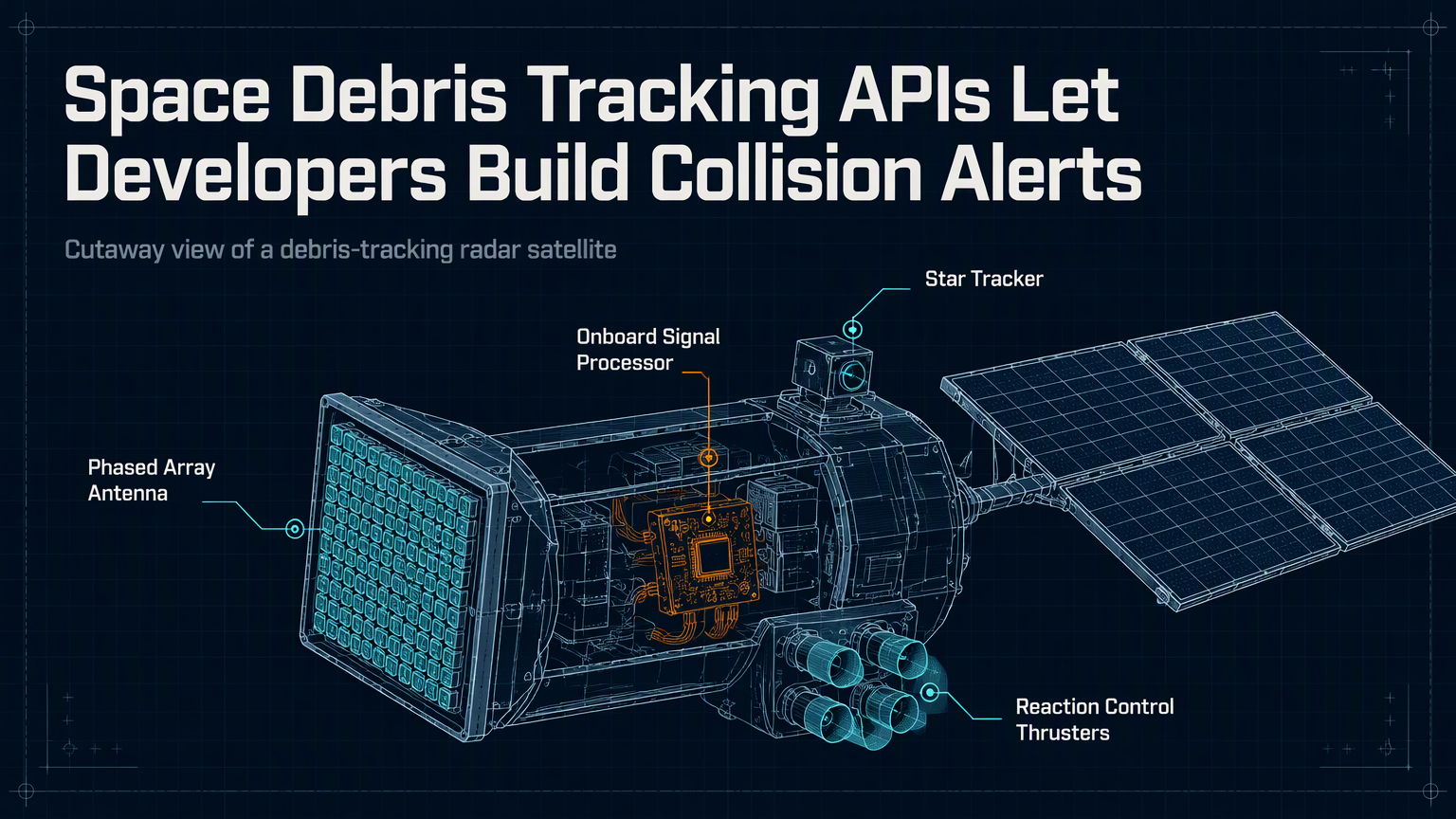
Your satellite just got a conjunction alert. Two kilometers miss distance. Probability of collision: 1.2e-4. You have six hours to decide whether to burn precious propellant or roll the dice. The alert didn't come from a government dashboard. It came from an API call your CI/CD pipeline made at 3 AM.
The Shift from Dashboards to Pipelines
Space situational awareness (SSA) used to mean analysts staring at screens at the 18th Space Defense Squadron. Now it means JSON payloads hitting your webhook. Companies like LeoLabs, Kayhan Space, Slingshot Aerospace, and Privateer expose REST and GraphQL endpoints that serve conjunction data messages (CDMs), ephemeris, and covariance matrices in real time. The data sources haven't changed: ground-based radars (S-band, X-band), optical telescopes, and increasingly, space-based sensors. What changed is the delivery mechanism. Developers can now treat orbital mechanics like any other external dependency.
What a Conjunction API Actually Returns
The covariance matrices are the key. They're 6x6 position-velocity uncertainty ellipsoids. Most developers won't invert them manually. SDKs in Python, Rust, and TypeScript handle the probability-of-collision (Pc) calculation using Foster or Chan methods. You subscribe to a webhook, filter by your NORAD IDs, and get alerts when Pc exceeds your threshold.
Building the Alert Pipeline
A production collision alert system needs three layers: ingestion, enrichment, and notification. Ingestion pulls CDMs via webhook or long-poll. Enrichment cross-references your asset database, checks maneuver history, and runs Monte Carlo simulations for edge cases. Notification routes to PagerDuty, Slack, or your mission ops console. The whole stack runs serverless. Here's a minimal Python handler:
Rate Limits and Data Freshness
Free tiers typically cap at 1,000 objects and 100 CDMs per day. Enterprise plans push to 10,000 objects with sub-hour latency. LeoLabs' API updates every 4 hours from their phased-array radar network. Kayhan pulls from multiple commercial sensors and advertises 30-minute refresh. Privateer's Wayfinder aggregates 18th SDS public data plus commercial feeds. None offer SLAs on collision prediction accuracy. The covariance realism varies by sensor type and tracking history. Always validate against a second source before maneuvering.
⚠️
WarningNever automate a burn decision solely on a single API's Pc value. Covariance realism errors of 2-3x are common. Require human-in-the-loop for any maneuver.
Authentication and Schema Drift
APIs use OAuth2 or API keys. Schema versioning is inconsistent. LeoLabs versions via URL path (/v2/cdm). Kayhan uses Accept headers. Privateer publishes OpenAPI specs but changes field names between minor releases. Pin your SDK versions. Write contract tests against recorded payloads. Treat schema drift like any third-party dependency: monitor, alert, and have a fallback parser.
The Orbital Data Standard Problem
CDM format (CCSDS 508.0) is standardized. Ephemeris formats (OEM, KVN) are standardized. API envelopes are not. Every vendor wraps the standard in proprietary pagination, filtering, and webhook signatures. The Space Data Association advocates for a common API spec. Until then, write an adapter layer. Normalize to an internal CDM schema. Swap providers without rewriting your enrichment logic.
"The best collision avoidance system is the one that never wakes you up for a false alarm.
— Dr. Moriba Jah, Privateer Space
What to Build This Week
Pick one provider. Register for a developer account. Subscribe to webhook events for a single test NORAD ID (use a Starlink satellite, they're plentiful). Log every payload for two weeks. Build a dashboard showing Pc distribution, miss distance trends, and sensor source attribution. Then add a second provider and diff the CDMs for the same conjunction. You'll see 20-40% Pc variance. That variance is your engineering margin. Design your alert thresholds around it.