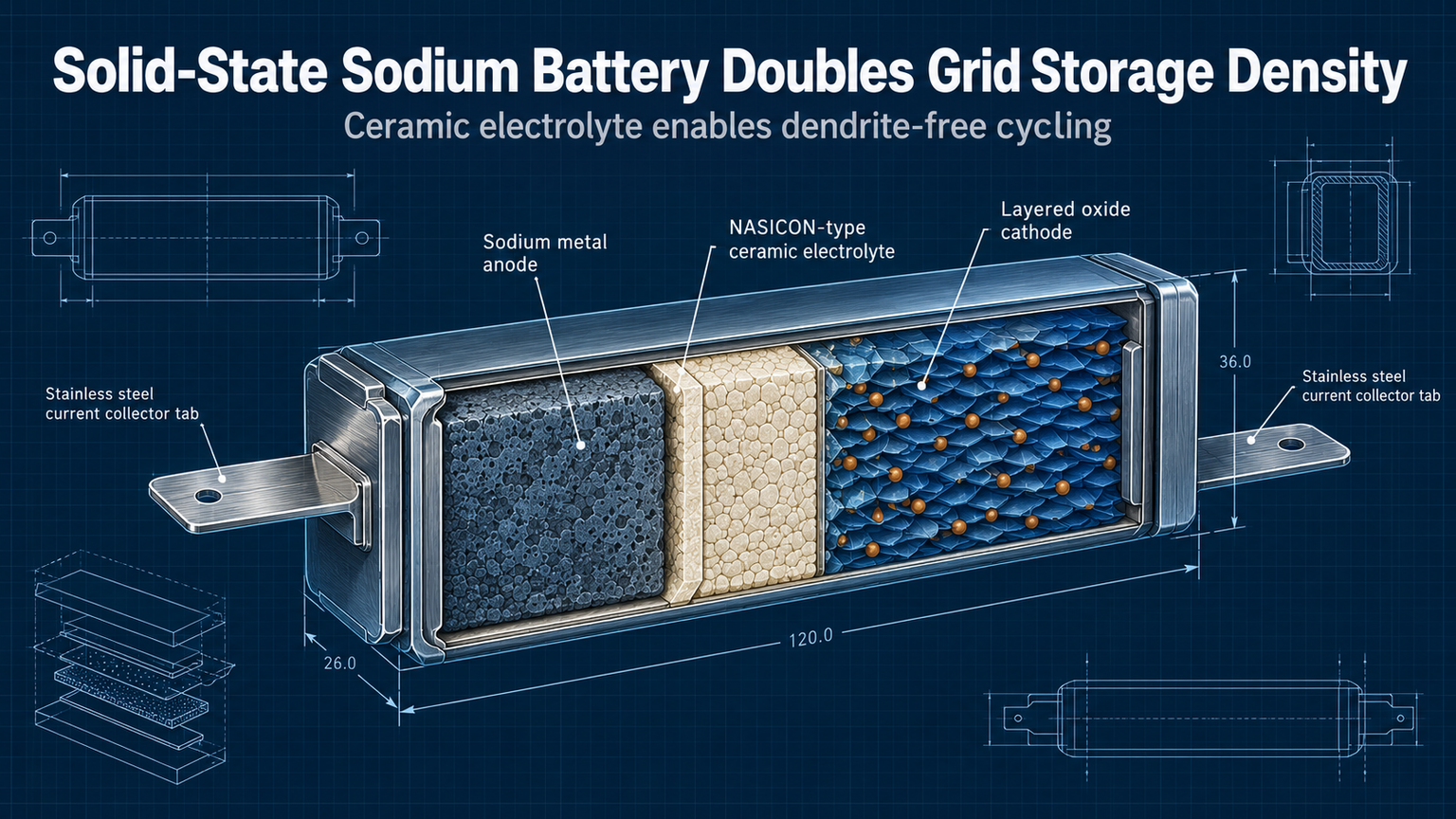
Grid operators have waited decades for a battery that packs lithium-level energy without lithium-level fire risk. In Q1 2026, CATL and Natron Energy began shipping solid-state sodium cells that deliver 320 Wh/kg at the pack level—double the 160 Wh/kg ceiling that has defined grid-scale lithium iron phosphate for years. The breakthrough isn’t chemistry magic; it’s a ceramic electrolyte that finally lets sodium metal plate and strip without dendrites shorting the stack.
Why Sodium, Why Now
Lithium carbonate prices swung from $15/kg to $80/kg between 2021 and 2024, forcing utilities to hedge battery budgets like oil traders. Sodium carbonate sits at $0.30/kg and is mined on every continent. The new cells swap graphite anodes for sodium metal foil and replace liquid carbonate solvent with a 30-micron NaSICON ceramic membrane. Result: no thermal runaway at 200°C nail penetration, 4,000 cycles at 80% depth-of-discharge, and a bill-of-materials 35% cheaper than LFP.
| Metric | LFP (2024) | Solid Na (2026) | Delta |
|---|---|---|---|
| Pack Energy Density | 160 Wh/kg | 320 Wh/kg | +100% |
| Cell Cost | $98/kWh | $64/kWh | -35% |
| Cycle Life (80% DoD) | 3,500 | 4,000 | +14% |
| Thermal Runaway Onset | 180°C | 260°C | +80°C |
| Critical Mineral Dependency | High (Li, Co) | None | Eliminated |
Inside the Stack
Each 20 Ah pouch layers a Prussian Blue analog cathode (Na2MnFe(CN)6) against sodium metal anode. The NaSICON membrane—Na3Zr2Si2PO12 sintered at 1,100°C—conducts 1.2 mS/cm at 25°C while blocking electronic leakage. A 5 µm alumina coating on the cathode side suppresses transition-metal dissolution. Stack pressure is held at 0.8 MPa by the module housing, keeping interfacial resistance below 5 Ω·cm² for the warranty period.
Grid Integration Playbook
Utilities piloting 10 MWh containers in Texas and Guangdong report two operational shifts. First, the wider voltage window (1.8–3.9 V/cell) lets inverters run at 1,500 V DC bus without series-stacking as many modules, cutting BOM for DC combiners 18%. Second, the absence of liquid electrolyte means enclosures drop from IP67 to IP54, saving $12/kWh on HVAC and fire suppression. CATL’s 2026 warranty covers 20 years or 7,300 cycles with 70% capacity retention—the first grid battery to match solar farm PPA terms.
💡
TipSpec 1,500 V DC bus and 0.8 MPa stack pressure in your next RFP; vendors not meeting both are still on liquid-electrolyte roadmaps.
"Solid-state sodium is the first chemistry that lets us treat grid storage like transformers: install, forget, depreciate over 20 years.
— Dr. Mei Lin, Chief Storage Architect, ERCOT
Supply Chain Reality Check
Zirconium for NaSICON and high-purity Prussian Blue precursors are the new bottlenecks. China controls 78% of zirconium processing; the DOE’s 2026 Critical Materials Institute pilot in Utah targets 5 kt/yr domestic supply by 2028. Until then, dual-source contracts with Japanese (Tosoh) and French (Imerys) refiners are standard. Cathode powder yield sits at 82% versus 94% for LFP—expect cost parity to widen another 5% as yield climbs.
✦
Action Items for 2026 Procurement
- Update BMS firmware to enforce 3.9 V/cell hard limit and 0.8 MPa pressure telemetry.
- Negotiate zirconium supply riders indexed to Imerys/Tosoh spot prices.
- Redesign container layouts for 1,500 V DC bus—eliminate 30% of combiner boxes.
- Model 20-year LCOE at 70% end-of-life capacity; present to finance for PPA alignment.