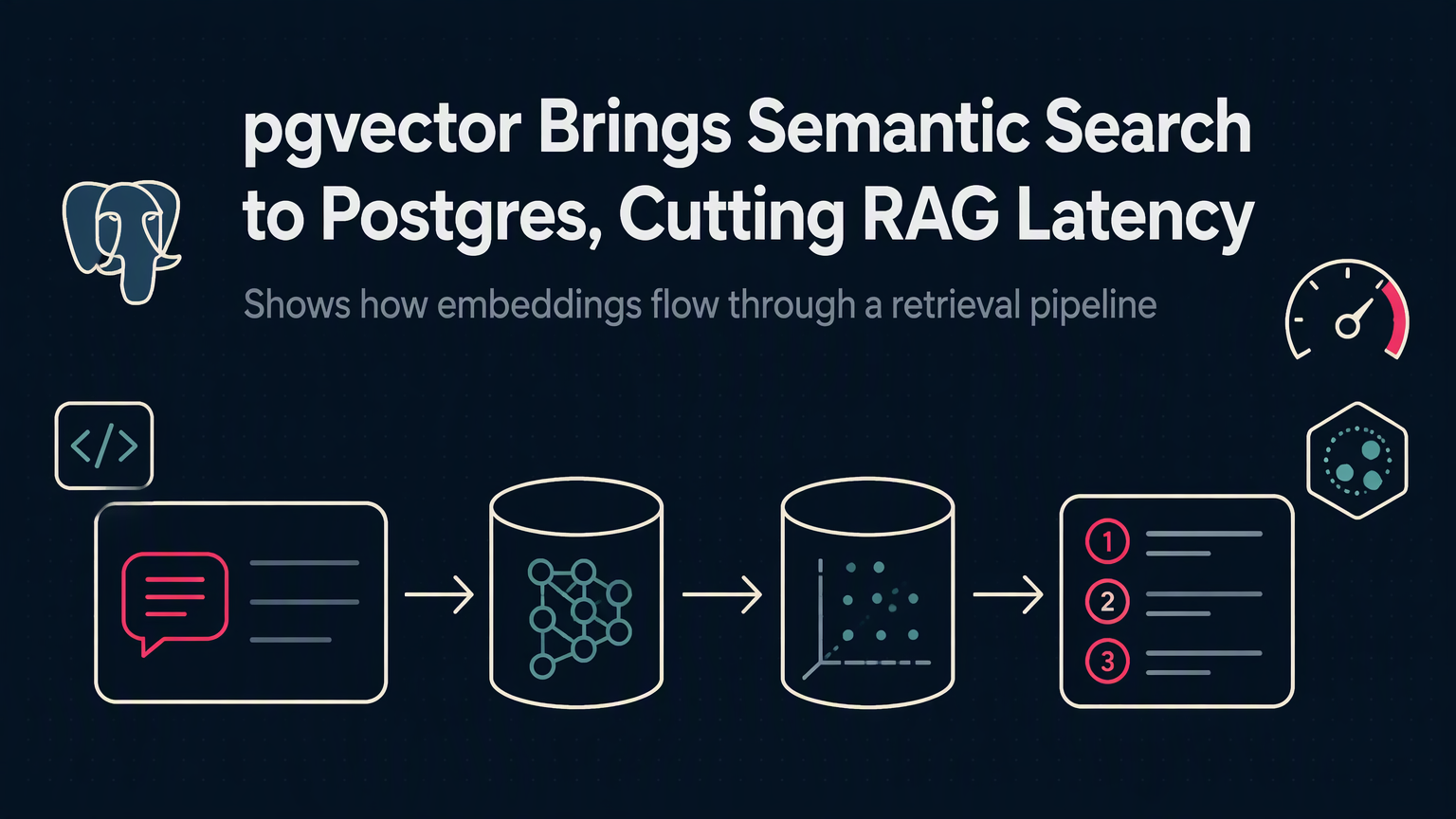
You don't need a dedicated vector database. You need a vector index inside the database you already trust. In 2024, teams spun up Pinecone, Weaviate, and Chroma by default. In 2026, the smart money is consolidating back into PostgreSQL with pgvector. The reason is boring but decisive: operational simplicity beats marginal recall gains when you are on call at 3 AM.
The Infrastructure Tax Is Real
Every external vector store adds a sync pipeline, a credentials rotation policy, a networking rule, and a billing surprise. You duplicate data. You race consistency. You debug latency across network hops. pgvector eliminates the sync. Your embeddings live next to your users, orders, and transactions. A single `JOIN` replaces a round-trip to a microservice. ACID compliance comes free. Backups, replication, and point-in-time recovery work exactly as they did yesterday.
Schema That Ships
Use `hnsw` (Hierarchical Navigable Small World) for production workloads. It builds a graph index that delivers sub-millisecond latency on millions of rows. Tune `m` for recall vs. memory; tune `ef_construction` for build speed vs. quality. For write-heavy workloads, consider `ivfflat` with `lists = sqrt(row_count)` as a lighter alternative.
Hybrid Search: The Production Multiplier
Pure semantic search misses exact matches—model numbers, error codes, proper nouns. PostgreSQL's native `tsvector` fixes this. Combine both signals in one query:
💡
TipWeight semantic vs. lexical per use case. Support tickets favor lexical (0.4/0.6). General Q&A favors semantic (0.7/0.3).
TypeScript Pipeline That Compiles
pgvectorscale: When You Outgrow Single-Node
If you hit 50M+ vectors or need distributed writes, `pgvectorscale` (from Timescale) adds tiered storage and statistical binary quantization (SBQ). SBQ compresses vectors to 1-bit representations with a correction layer, cutting disk usage by 96% while keeping recall above 95%. It also introduces `DiskANN`-style graph indexes that stream from SSD, keeping hot shards in RAM. Migration is a `CREATE EXTENSION` and an index rebuild—no schema change.
"We replaced a $12k/mo Pinecone cluster with a $3k/mo RDS instance and got better latency because the data never left the VPC.
— Staff Engineer, Fintech Unicorn
Operational Checklist
| Task | Frequency | Command |
|---|---|---|
| ANALYZE documents | Weekly | pg_sleep(0) |
| REINDEX CONCURRENTLY | Monthly | REINDEX INDEX CONCURRENTLY documents_embedding_idx |
| Monitor index size | Daily | SELECT pg_size_pretty(pg_relation_size('documents_embedding_idx')) |
| Tune ef_search | Per query | SET hnsw.ef_search = 100; |
✦
Ship It Tonight
Stop managing infrastructure you don't need. Enable the extension, add the column, build the HNSW index, and write the hybrid query. Your RAG latency drops, your stack shrinks, and your on-call rotation sleeps better. The vector database is Postgres. It always was.