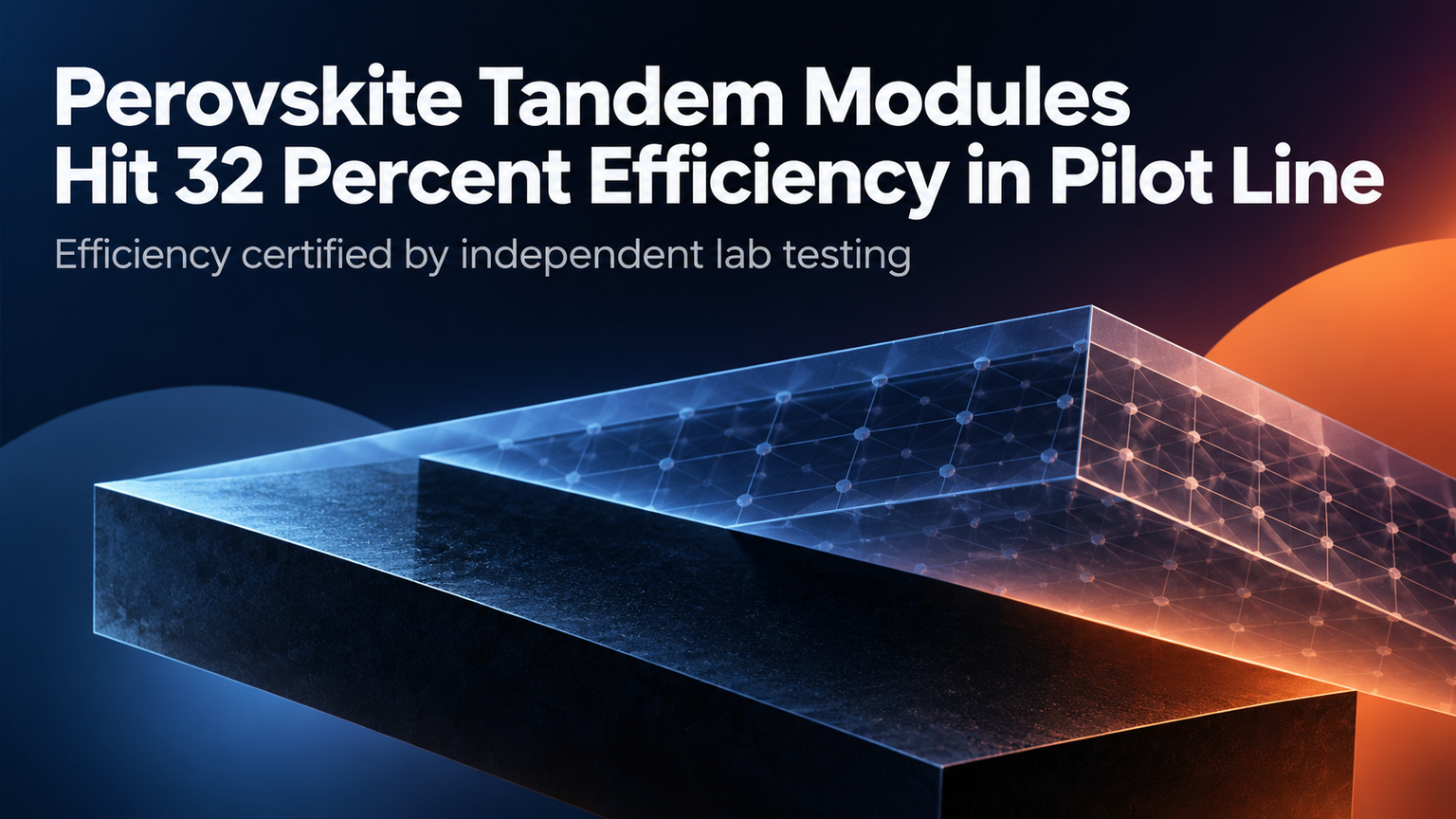
Perovskite-silicon tandem modules just cleared 32 percent certified efficiency on a pilot production line. Not a lab cell. A module. That threshold separates research curiosity from commercial reality, and it arrived in 2026 from Oxford PV's Brandenburg factory and LONGi's pilot runs in Xi'an.
What Changed in 2026
Three things moved simultaneously. First, Oxford PV shipped 72-cell tandem modules at 26.8 percent aperture efficiency — 1.5 points above the best mass-production silicon. Second, LONGi certified a 33.9 percent tandem cell and demonstrated 27.1 percent on a 60-cell pilot module. Third, encapsulation lifetimes passed IEC 61215 damp-heat and thermal-cycling sequences without the catastrophic delamination that killed earlier runs.
"The efficiency delta is real, but the yield delta is what pays for the factory. We're seeing 92 percent line yield on encapsulation now versus 68 percent eighteen months ago.
— Dr. Chris Case, CTO Oxford PV
The Stability Gap Is Narrowing, Not Closed
Perovskite decomposition under heat, moisture, and UV remains the physics problem. The 2026 breakthrough is not a new chemistry — it's a multilayer barrier stack: atomic-layer-deposited Al2O3, UV-cut encapsulant, and edge-seal geometry borrowed from OLED manufacturing. Pilot modules now project 25-year T80 lifetimes under standard conditions. Real-world desert and coastal deployments will validate or falsify that projection by 2028.
⚠️
WarningDo not spec tandem for projects requiring bankable 25-year performance warranties today. Warranty products lag pilot data by 18-24 months.
Why C&I Buyers in India Should Not Wait
India's commercial and industrial segment pays Rs 5.5-7.5 per kWh for grid power. Rooftop silicon at 21 percent module efficiency delivers levelized cost of energy around Rs 2.8-3.2 per kWh over 25 years. Tandem at 26.8 percent cuts balance-of-system costs — racking, land, wiring, installation labor — by roughly 18 percent. That pushes LCOE below Rs 2.5 per kWh even with a 30 percent module price premium.
| Metric | Silicon (TOPCon) | Tandem (Pilot 2026) |
|---|---|---|
| Module Efficiency | 21.5% | 26.8% |
| BOS Cost per kW | Rs 18,500 | Rs 15,200 |
| Module Price Premium | Baseline | +30% |
| 25-Year LCOE | Rs 3.05/kWh | Rs 2.42/kWh |
The math works if you can secure supply. Oxford PV's 2026 capacity is 150 MW. LONGi's pilot line targets 50 MW. Global demand for high-efficiency rooftop alone exceeds 5 GW annually. Early procurement agreements — not spot buying — are the only path to capture the BOS savings.
Procurement Playbook for 2026-2027
First, sign capacity reservation agreements with Oxford PV or LONGi now. Deposits are refundable if IEC 61730 certification slips. Second, redesign your standard rooftop BOM for 72-cell tandem form factor — taller modules, different clamp zones, revised string voltage. Third, negotiate performance guarantees tied to damp-heat extrapolation data, not just STC flash tests. Fourth, budget for independent third-party degradation monitoring on your first 500 kW deployment.
💡
TipUse the 18-month certification lag as your internal validation window. Pilot modules on your roof, bankable warranties on the next order.
The Bottom Line
Perovskite tandem is no longer a science experiment. It is a manufacturing ramp with a clear efficiency advantage and a narrowing reliability gap. For Indian C&I buyers, the levelized cost math already favors early adoption — if you move before the pilot capacity sells out.
✦
ℹ️
NoteNext step: Request Oxford PV and LONGi pilot allocation schedules. Align your 2027 capex plan with their H2 2026 delivery slots.