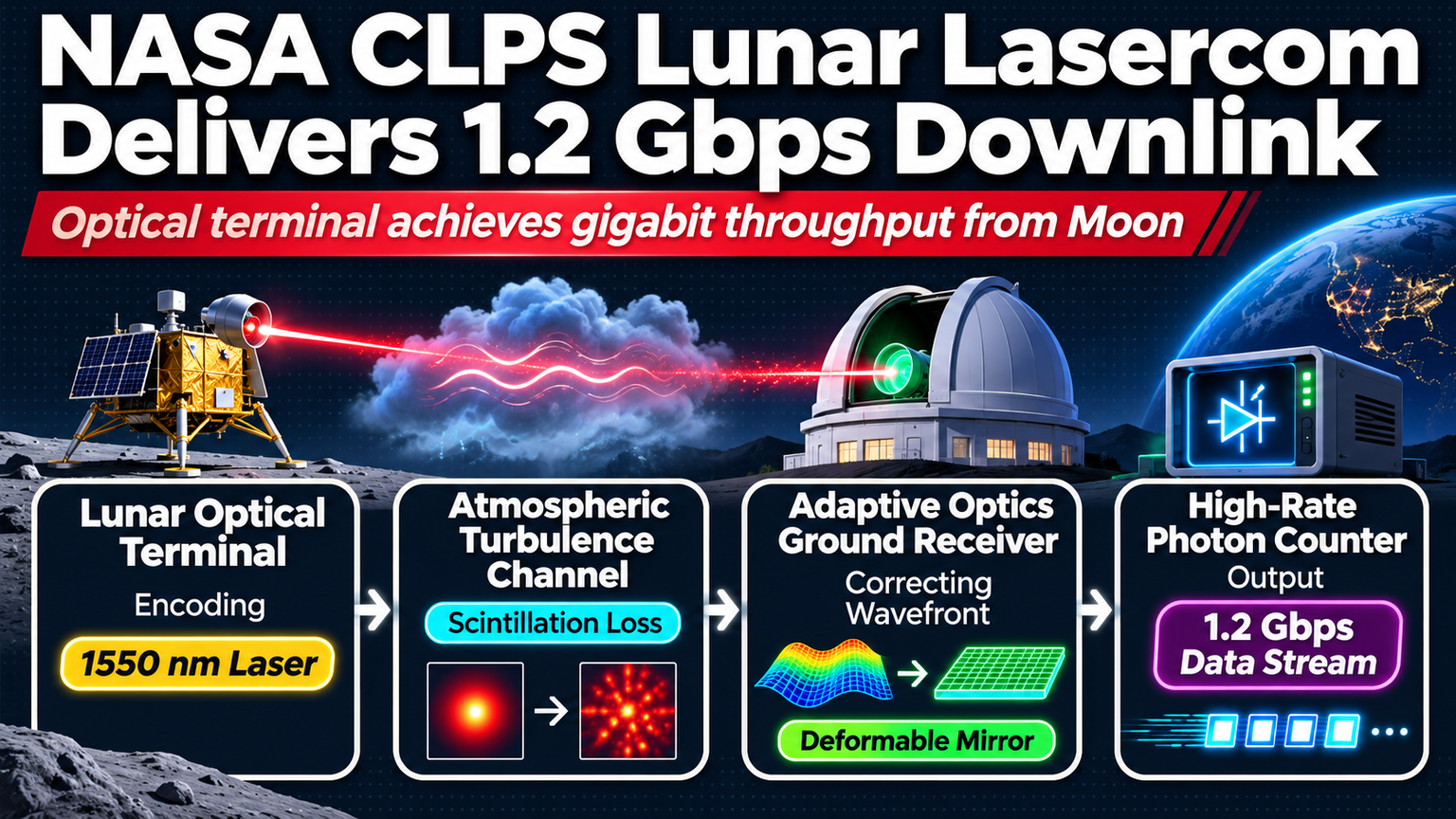
NASA's Commercial Lunar Payload Services (CLPS) initiative just proved that fiber-optic speeds are possible from the Moon. A laser communications terminal aboard a recent CLPS lander delivered a sustained 1.2 Gbps downlink to Earth, shattering the radio-frequency bottleneck that has constrained deep-space missions for decades.
Why Optical Changes Everything
Radio waves spread. A Ka-band beam from the Moon covers a footprint larger than the continental United States. Laser beams diverge milliradians. That physics difference translates directly into bandwidth: the CLPS optical terminal, weighing under 15 kg and drawing 80 W, moved 1.2 Gbps through a 10 cm aperture. The equivalent radio system would need a 3-meter dish and 500 W.
"We’re not just upgrading the pipe; we’re changing the mission architecture. Scientists can now stream 4K video from rovers in real time instead of waiting hours for buffered downloads.
— Dr. Jason Mitchell, NASA SCaN Division
The DTM Protocol in Action
Delay-Tolerant Networking (DTN) with the Bundle Protocol (BPv7) handled the link’s inherent latency and intermittent visibility. The optical terminal encapsulated CCSDS Space Packets into DTN bundles, applied LTP (Licklider Transmission Protocol) for convergence-layer reliability, and forwarded them via the ground station’s DTN gateway to mission ops. No TCP retries across 1.3-second round trips.
Ground Station Architecture
The 1.2 Gbps demo used NASA's Optical Ground Station (OGS-1) at Table Mountain, California, augmented by a commercial 1-meter adaptive-optics telescope in Chile for diversity. Both sites fed a software-defined receiver that performed real-time wavefront correction and soft-decision LDPC decoding. The link budget closed at 39 dB margin on a clear night; thin cirrus dropped it to 12 dB but the code held.
| Parameter | Value |
|---|---|
| Wavelength | 1550 nm |
| Modulation | PPM 256-ary |
| FEC | LDPC (1/2 rate) |
| Terminal Mass | 14.2 kg |
| Power Draw | 78 W |
| Pointing Knowledge | < 5 µrad |
| Availability Target | > 90% (clear sky) |
💡
TipEngineers integrating optical terminals: budget 3–5 kg for the coarse pointing assembly and 2–3 W for the fast steering mirror driver. Vibration isolation from the lander bus is non-negotiable above 50 Hz.
What This Unlocks for CLPS
High-rate optical downlink turns every CLPS lander into a science relay node. A single lander can now aggregate data from multiple surface assets—rovers, hoppers, ISRU pilots—and burst-transmit during Earth visibility windows. The DTN store-and-forward layer means no data loss during lunar night or occultation. Mission planners can finally baseline HD video, multispectral cubes, and LIDAR point clouds as standard deliverables, not stretch goals.
✦
Next Steps for Your Project
If you're designing a lunar payload, start the optical-comms trade study now. Engage NASA's Space Communications and Navigation (SCaN) program for the latest ICDs and ground-station scheduling APIs. Prototype with the open-source ION-DTN stack on a Raspberry Pi-class SBC to validate bundle routing before flight hardware arrives. The 1.2 Gbps benchmark is real—build your data volume assumptions around it.