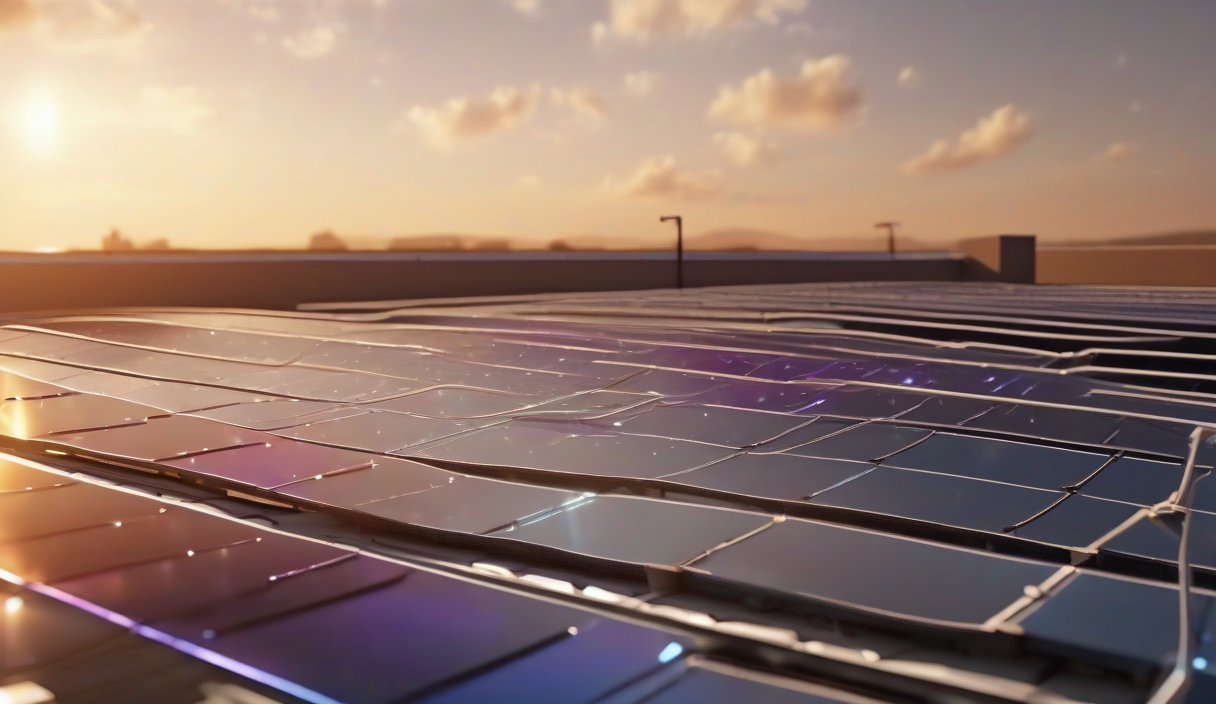
Silicon solar hit a wall. After decades of incremental gains, single-junction cells are bumping against the 29% practical ceiling. Enter perovskite-silicon tandems: the first photovoltaic technology to shatter that limit in commercial production, not just lab notebooks.
The Efficiency Leap Is Real
LONGi's NREL-certified 34.85% tandem cell, announced in 2026, isn't a one-off hero device. It represents a manufacturing-ready architecture where a wide-bandgap perovskite top cell harvests blue photons while a silicon bottom cell captures red and infrared. The result: more watts per square meter, lower balance-of-system costs, and faster payback for utility and rooftop deployments alike.
| Metric | Silicon (Best Commercial) | Perovskite-Si Tandem (2026) |
|---|---|---|
| Module Efficiency | 22-24% | 28-30% |
| Theoretical Limit | ~29% | ~43% |
| Temp Coefficient | -0.35%/°C | -0.28%/°C |
| Energy Payback | 1.5-2 years | <1 year (est.) |
Two Hurdles: Stability and Lead
Efficiency headlines obscure the engineering grind. Perovskites degrade under heat, humidity, and UV — the exact conditions on a rooftop. Encapsulation stacks borrowed from OLED manufacturing (thin-film barriers, edge seals, getter layers) now pass IEC 61215 damp-heat and thermal-cycling sequences, but 25-year field data doesn't exist yet. Accelerated testing suggests 20+ year lifetimes; bankability hinges on insurers accepting those models.
⚠️
WarningLead content remains ~0.3 g/m² in the perovskite layer. Regulatory frameworks (EU RoHS, REACH) currently exempt PV, but end-of-life recycling mandates are tightening. Design for recycling — soluble encapsulants, mechanical delamination — must be baked in now, not retrofitted.
Manufacturing: From Spin-Coat to Slot-Die
Lab records used spin-coating — fine for 1 cm², useless for GW lines. The shift to slot-die coating and blade coating on glass or flexible substrates enables roll-to-roll throughput >10 m/min. Inline plasma treatment, thermal annealing zones, and optical monitoring keep composition uniform across meter-wide webs. Oxford PV's Brandenburg line and LONGi's pilot fab prove the flow; the next step is yield >95% at scale.
Where the Money Flows
Early adopters aren't waiting for perfection. Utility developers in high-irradiance, land-constrained markets (Middle East, Australia, Japan) are signing PPAs with tandem modules at $0.22-0.25/W — a premium over silicon's $0.16/W that pencils out when land, labor, and interconnection costs dominate. Rooftop installers in Europe and California see higher revenue per limited roof area. The investment thesis: pay the premium now, capture the learning curve, own the supply chain when tandem hits cost parity (~2028).
"We're not betting on a material. We're betting on a manufacturing platform that delivers more energy per kilogram of deployed hardware.
— Dr. Chris Case, CTO, Oxford PV
Action Plan for Decision Makers
💡
Tip1. Pilot 50-100 kW of tandem modules on your next project — negotiate performance warranties tied to IEC 63209 (perovskite-specific testing). 2. Require supply-chain transparency on lead management and recycling partners. 3. Model LCOE with 0.5%/yr degradation (conservative) vs silicon's 0.4%/yr; the efficiency delta still wins. 4. Engage insurers early — Munich Re and Swiss Re now offer parametric policies for novel PV tech.
✦
Perovskite-silicon tandems have crossed the lab-to-fab chasm. The physics works. The manufacturing scales. The remaining risks — durability proof, lead stewardship, bankability — are engineering and finance problems, not science gaps. For developers and investors willing to underwrite the learning curve, the reward is the first genuine step-change in solar economics since PERC. The 30% module era has arrived; the 35% era is visible.