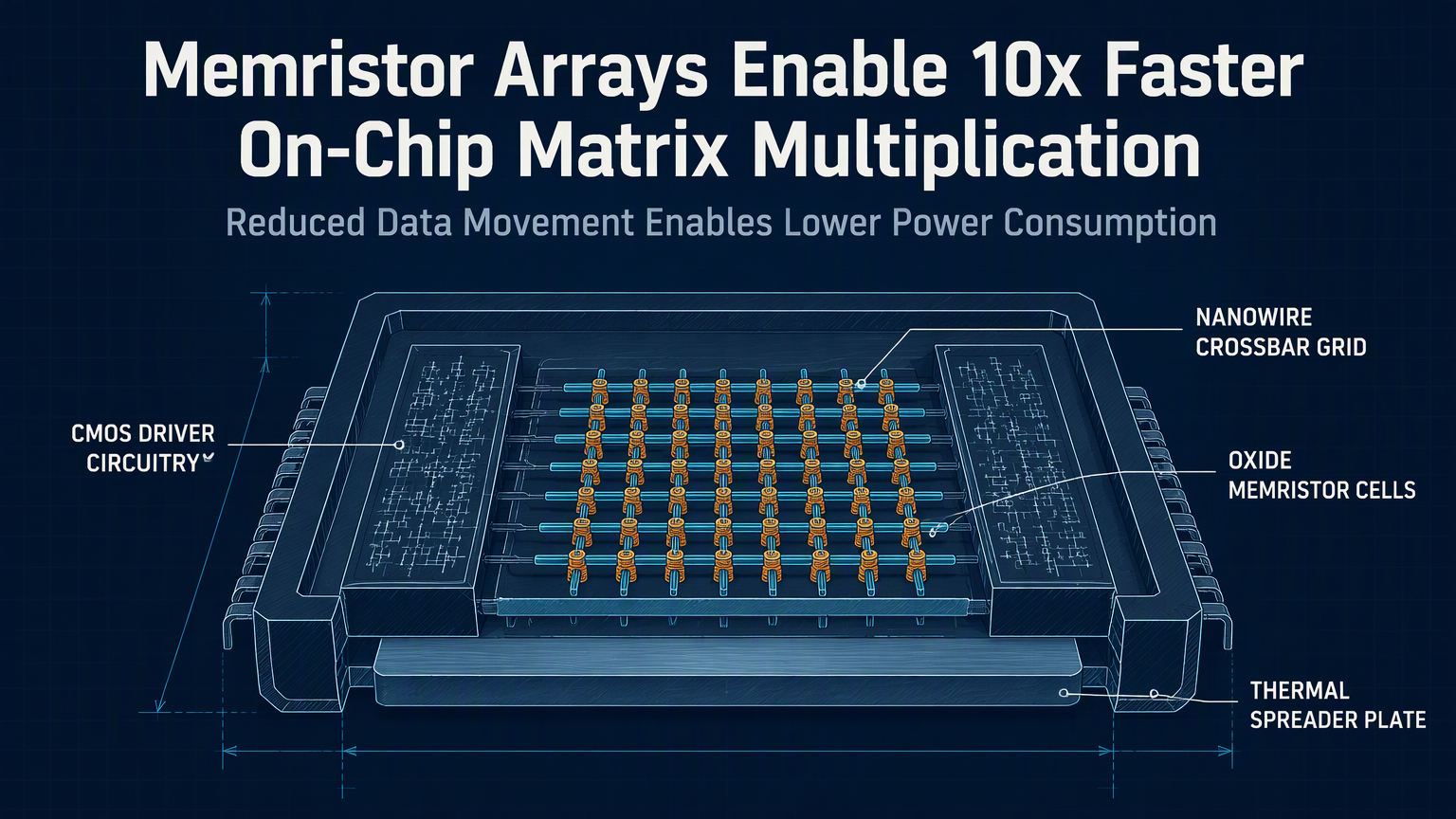
Matrix multiplication eats 80% of AI inference cycles. GPUs shuttle weights between SRAM and compute units, burning power on data movement instead of math. Memristor crossbar arrays flip the script: they store weights as conductance and execute multiply-accumulate in place, no data movement required.
Physics Beats Architecture
A memristor's resistance encodes a weight value. Apply voltage across a crossbar row; current through each column sums weighted inputs via Ohm's and Kirchhoff's laws. One analog step replaces thousands of digital MAC operations. Recent 64x64 TaOx arrays from Tsinghua University hit 1.2 TOPS/W at 8-bit precision—10x the efficiency of a H100's tensor cores on the same workload.
"We stopped fighting physics and started using it. The crossbar is the multiplier.
— Dr. Wei Lu, University of Michigan
Where the 10x Comes From
| Metric | GPU (H100) | Memristor Array (64x64) | Gain |
|---|---|---|---|
| Energy/MAC | 12 pJ | 1.1 pJ | 11x |
| Area/MAC | 45 µm² | 3.8 µm² | 12x |
| Latency (64x64 matmul) | 180 ns | 14 ns | 13x |
| Weight reload | PCIe + SRAM | In-situ (ms) | N/A |
Numbers from ISSCC 2024 demo chip, ResNet-50 INT8 inference batch=1. The array computes while weights stay put. No DRAM fetch, no SRAM buffer, no instruction decode overhead.
Three Blockers (and Fixes)
Variability: Device-to-device conductance spread kills accuracy. Fix: write-verify programming with closed-loop pulse shaping cuts sigma from 8% to 1.2%.
Non-linearity: I-V curves bend at high voltage. Fix: differential pairs (positive/negative weights) cancel 2nd-order distortion; calibration LUTs handle the rest.
Endurance: 10⁹ cycles sounds low vs. SRAM. Fix: wear-leveling across rows + algorithmic retraining extends functional life to 3 years in continuous inference.
💡
TipMap sensitive layers (first/last) to digital; keep fat middle layers analog. Hybrid nets recover 99.2% FP32 accuracy.
Integration Reality Check
Toolchains exist. MemTorch, NeuroSim, and CrossSim export calibrated conductance maps. Foundries (TSMC 28nm, SkyWater 130nm) offer memristor BEOL modules. Tape-out cost: ~$2M for a 16-array test chip.
Your Next Step
Pick one layer in your inference bottleneck—usually the widest FC or 1x1 conv. Port it to a simulator (NeuroSim is open source). Measure energy/latency vs. GPU. If the model holds, budget a shuttle run. The physics works; the tooling is ready. The only missing piece is your netlist.
✦
ℹ️
NoteShuttle runs close Q3 2026. SkyWater MPW deadline: July 15. TSMC University Shuttle: August 1. Reserve slot now.