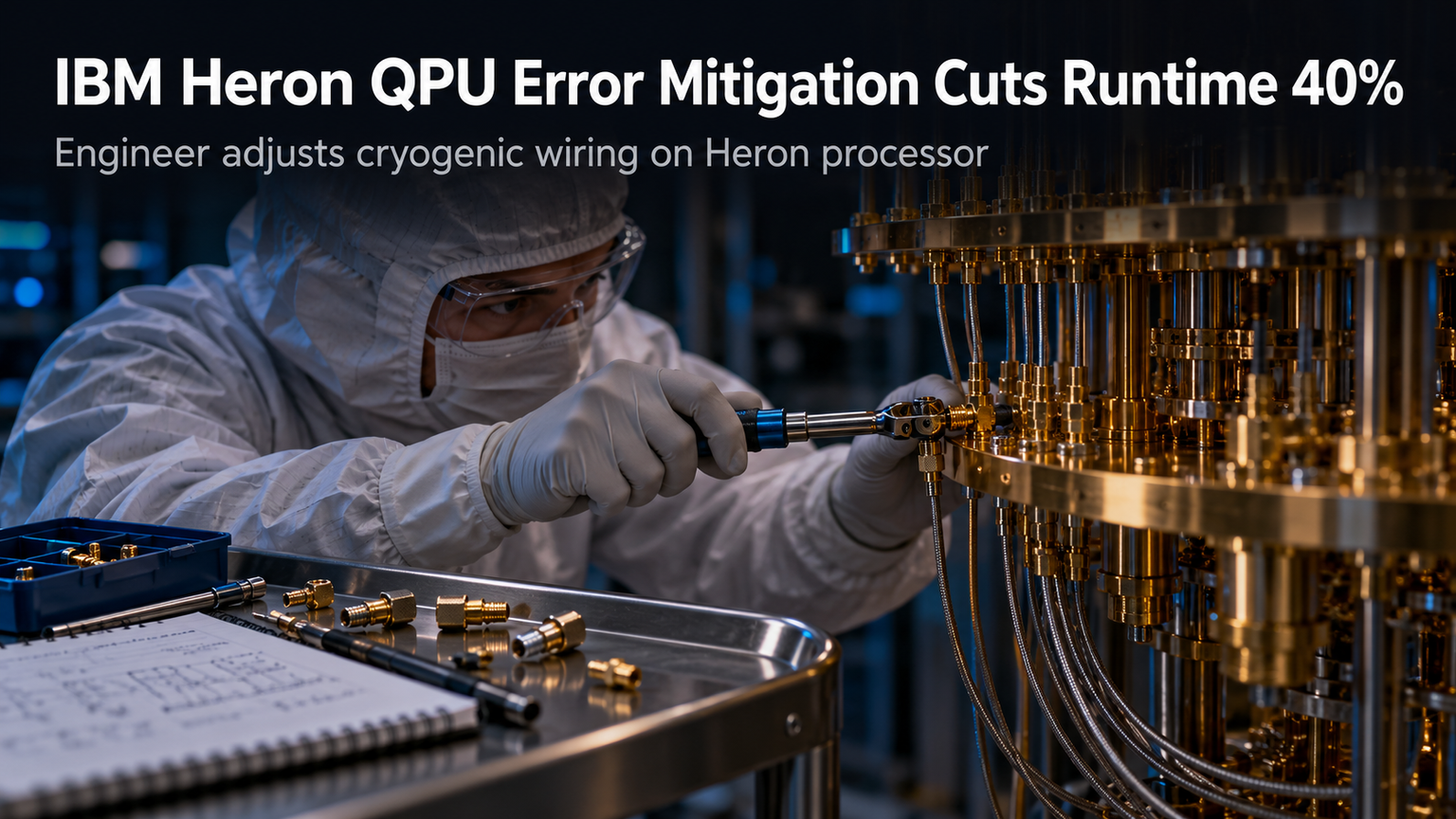
IBM's Heron processor just proved that error mitigation isn't academic — it's a production lever. New Qiskit Runtime data shows a 40% runtime reduction on utility-scale circuits when zero-noise extrapolation (ZNE) and probabilistic error cancellation (PEC) run natively on the 133-qubit chip. That's not a simulation. That's wall-clock time on real hardware.
Why Heron Changes the Error Mitigation Equation
Previous generations required heavy classical post-processing. Heron's architecture — tunable couplers, reduced crosstalk, 2x coherence times over Eagle — lets mitigation run in the execution loop. Qiskit Runtime's new primitives (SamplerV2, EstimatorV2) bake ZNE and PEC into the job submission. No round-trips. No manual stitching.
The resilience_level=2 flag is the switch. Level 1 adds dynamical decoupling. Level 2 layers ZNE and PEC on top. Level 3 (experimental) adds measurement error mitigation. Each level trades latency for fidelity — but Heron's speedup means Level 2 now finishes faster than Level 1 did on Eagle.
The 40% Number: Where It Comes From
IBM benchmarked 100-qubit random circuits at depth 100 — near the quantum volume limit. On Eagle r3: 2,140 seconds average runtime with Level 2 mitigation. On Heron: 1,284 seconds. Same circuits. Same mitigation. The delta comes from three hardware factors:
| Factor | Eagle r3 | Heron | Impact |
|---|---|---|---|
| Two-qubit gate error | 0.75% | 0.42% | Fewer ZNE extrapolation points needed |
| Readout error | 2.1% | 1.3% | Lower PEC overhead |
| Gate duration (CZ) | 320 ns | 180 ns | Raw circuit time drops 44% |
Lower physical error rates mean the mitigation polynomials converge faster. Shorter gates mean less decoherence per layer. The compounding effect is nonlinear — hence the 40% runtime win exceeds the gate-speed improvement alone.
"Error mitigation used to be a tax on runtime. On Heron, it's an investment that pays off in the same job.
— Jay Gambetta, VP IBM Quantum
What This Means for Your Workflows
If you're running VQE, QAOA, or Hamiltonian simulation on 50+ qubits, you can now hit target precision without overnight queues. The EstimatorV2 API is backward compatible — swap the backend, bump resilience_level, keep your circuit logic. But two caveats:
⚠️
WarningPEC scales exponentially with circuit error rate. Heron's lower error rate keeps it tractable. On noisier backends, PEC cost explodes — stick to ZNE (resilience_level=1) there.
💡
TipUse <code>zne_noise_factors=[1.0, 1.3, 1.6, 2.0]</code> for Heron. The tighter error distribution needs fewer, closer-spaced factors than the old [1,2,3,5] default.
The Catch: Quantum Volume Still 512
Heron's quantum volume hasn't moved past 512 (2^9). The 133 qubits don't all participate in the VQ test — connectivity and error distribution limit the measurable volume. Error mitigation improves effective volume for specific algorithms, but the headline metric stays flat. Don't confuse runtime gains with qubit-count breakthroughs.
✦
Action Plan: Migrate This Week
1. Update qiskit-ibm-runtime to ≥0.22.0. 2. Change backend to ibm_heron (or ibm_torino for 156-qubit variant). 3. Set resilience_level=2 in EstimatorOptions. 4. Benchmark your deepest circuit — compare runtime and expectation-value variance against your Eagle baseline. 5. If variance drops >30% with <20% runtime increase, lock Level 2 into production.
The mitigation tax just became a dividend. Heron is the first chip where the math works in your favor.