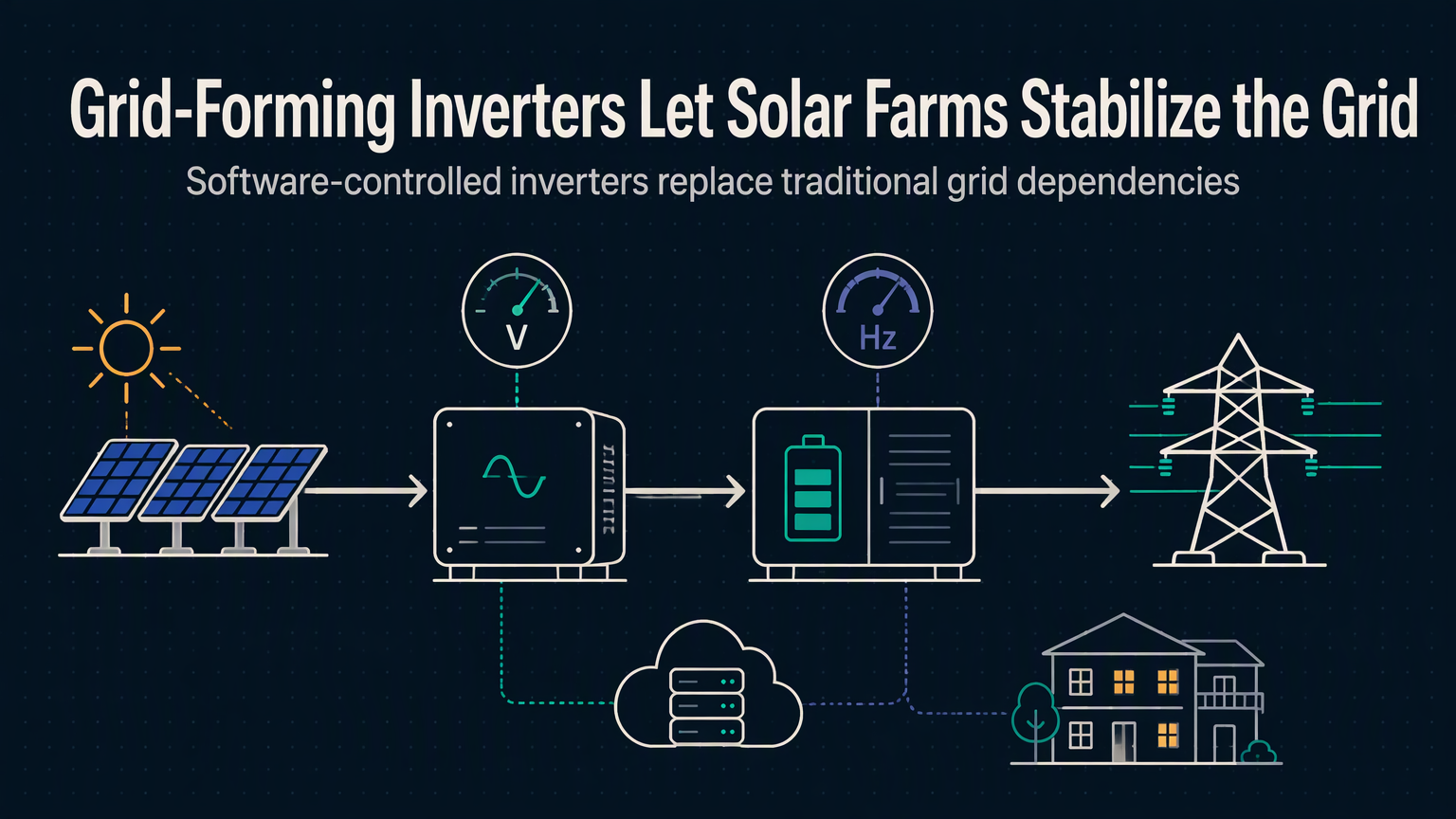
When a massive solar farm trips offline during a voltage sag, conventional inverters simply disconnect. They wait for the grid to recover before restarting. That passive behavior used to be acceptable when renewables were a rounding error on the system. Today, with solar and wind pushing 30% of annual energy in some regions, that passivity is a liability. Grid-forming inverters flip the script: they act like virtual synchronous machines, injecting voltage and frequency support the instant the system wobbles.
Why Grid-Following Falls Short
Standard grid-following inverters rely on a phase-locked loop (PLL) to synchronize with the existing voltage waveform. If the grid voltage distorts or the frequency drifts outside a narrow window, the PLL loses lock and the inverter trips. During the 2021 Texas freeze and the 2023 UK system split, thousands of megawatts of solar and battery resources went offline precisely when operators needed them most. Grid-forming control replaces the PLL with a voltage-source behavior that establishes its own voltage vector, allowing the asset to ride through faults and even black-start dead sections of the network.
"Grid-forming isn't a feature toggle; it's a fundamental architecture shift. You don't retrofit it with a firmware patch.
— Marta Alvarez, Principal Grid Integration Engineer
Control Modes That Matter
Three dominant architectures exist today. Virtual Synchronous Machine (VSM) emulates rotor inertia and damping through software swing equations. Matching control shapes the inverter output impedance to mimic a synchronous generator's Thevenin equivalent. Droop-based virtual oscillator control (VOC) uses nonlinear dynamics to synchronize without a PLL. Each has trade-offs: VSM is intuitive for protection engineers but computationally heavy; VOC scales better for massive plants but requires careful tuning of oscillator parameters. Most Tier-1 OEMs now offer selectable modes via their inverter control software stack, letting developers match the control strategy to the grid code requirement.
💡
TipAsk your OEM for the small-signal stability report (eigenvalue analysis) for your specific plant impedance and grid X/R ratio. Generic bench tests don't capture site-specific resonance risks.
Grid Code Evolution
ERCOT's NPRR1122, CAISO's Tariff Section 9, and the EU's NC RfG 2.0 now mandate grid-forming capability for new interconnecting resources above 20 MW. The requirements converge on three measurable capabilities: fault ride-through with reactive current injection (1.5 pu for 150 ms), black-start readiness within 5 seconds, and synthetic inertia provision (minimum 2 seconds at 0.5 pu/Hz). Compliance testing uses real-time hardware-in-the-loop (HIL) platforms like Typhoon HIL or OPAL-RT, not just offline studies. Developers should budget 3-6 months and $200k-$400k for full HIL validation before commercial operation date.
| Capability | ERCOT | CAISO | EU NC RfG 2.0 |
|---|---|---|---|
| Fault Ride-Through | 1.5 pu / 150ms | 1.5 pu / 150ms | 1.5 pu / 150ms |
| Black-Start | < 5 sec | < 5 sec | < 5 sec |
| Synthetic Inertia | 0.5 pu/Hz / 2s | 0.5 pu/Hz / 2s | 0.5 pu/Hz / 2s |
Integration Checklist for Developers
1. Confirm the inverter firmware version supports the required grid-forming mode and that the OEM provides a signed compliance letter for your target market.
2. Run EMT studies (PSCAD/EMTDC or RTDS) with the exact plant layout, including collector system cables and step-up transformers, to verify sub-synchronous control interaction (SSCI) margins.
3. Specify a grid-forming battery energy storage system (BESS) of at least 10% of plant capacity / 2-hour duration to cover the inverter's DC-link energy deficit during deep voltage sags.
4. Negotiate a grid-forming performance guarantee in the EPC contract: 99.5% availability of grid-forming mode, with liquidated damages for non-compliance.
5. Plan for annual re-certification; grid codes evolve faster than hardware lifecycles.
⚠️
WarningDo not assume a 'grid-forming ready' label means plug-and-play. Site-specific tuning of voltage controller bandwidth and current limitation logic is mandatory.
The Economic Case
Grid-forming inverters carry a 3-5% capex premium over grid-following units. However, they unlock stacked revenue streams: frequency regulation ancillary services ($8-12/kW-yr in ERCOT), capacity payments for black-start designation, and avoidance of curtailment during weak-grid conditions. A 200 MW solar + 50 MW/100 MWh BESS plant in West Texas modeled a 4.2-year payback on the grid-forming premium solely from ancillary service uplift. The math improves further when developers factor in reduced curtailment risk during spring shoulder months.
✦
Grid-forming inverters transform solar farms from passive energy sources into active grid assets. The technology is proven, the grid codes are written, and the revenue models are clear. Developers who specify grid-forming today avoid costly retrofits tomorrow and capture value streams that grid-following plants simply cannot access. Start the conversation with your OEM and transmission planner now — before the interconnection agreement locks in yesterday's architecture.