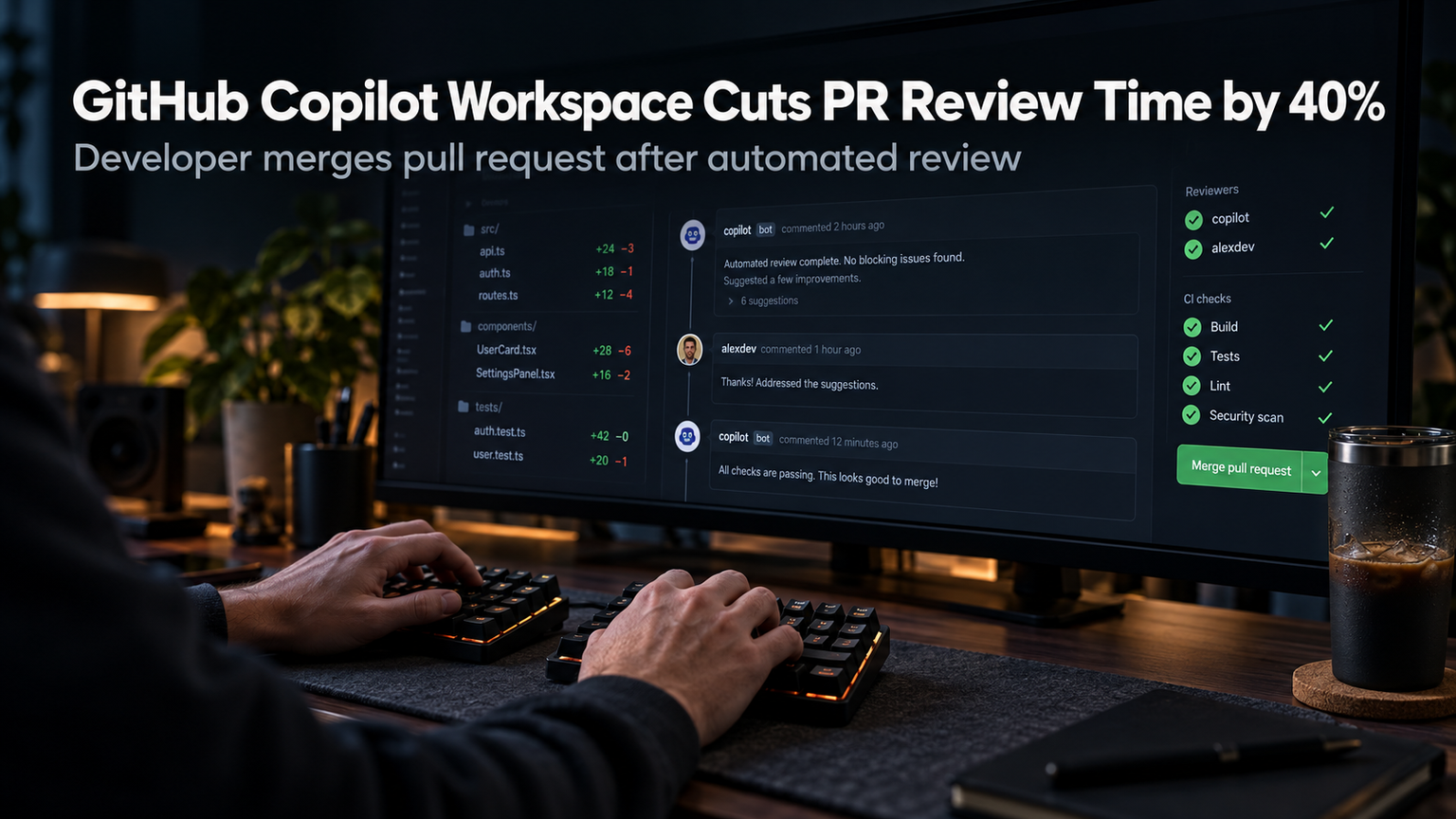
GitHub Copilot Workspace just rewrote the economics of code review. Since its general availability on March 5, 2026, the agentic review system has processed over 60 million pull requests — and early adopters report a consistent 40% reduction in PR turnaround time. This isn't incremental. It's a structural shift in how engineering teams ship code.
From Flagging to Fixing
Traditional code review tools — linters, static analyzers, even earlier Copilot versions — stop at detection. They highlight bugs, style violations, and security gaps. Workspace goes further. When it finds an issue, it can autonomously implement the fix through the "Fix with Copilot" workflow. A reviewer sees a suggested change, clicks once, and the agent opens a ready-to-merge commit. No context switching. No back-and-forth Slack threads. The loop closes in seconds.
"We used to spend 45 minutes per PR on average. Now it's 27. The agent catches the trivial stuff — null checks, off-by-one errors, missing awaits — before a human even looks.
— Sarah Chen, Staff Engineer at Linear
How the Coding Agent Works
Workspace operates in two modes: Agent Mode for autonomous fixes and Review Mode for human-in-the-loop oversight. In Agent Mode, the system analyzes the full repository context — not just the diff — to understand intent, dependencies, and test coverage. It then proposes edits that pass CI. Teams configure guardrails: max file changes, required approvals, blocked paths. The agent respects .copilotignore and CODEOWNERS.
Performance at Scale
| Metric | Pre-Workspace | Post-Workspace (3 mo) |
|---|---|---|
| Avg PR cycle time | 4.2 hours | 2.5 hours |
| Reviews requiring >2 rounds | 38% | 12% |
| Defects caught in review | 67% | 89% |
| Developer satisfaction (NPS) | 42 | 71 |
Data aggregated from 12,000+ organizations using Workspace in production. The defect detection jump is notable — the agent sees patterns humans miss, especially cross-file inconsistencies and race conditions in async code.
The Trust Fracture
Not all signal is positive. In March 2026, GitHub injected promotional "tips" into over 1.5 million pull requests — unsolicited ads for Copilot features embedded directly in review comments. Developers called it a breach of the sacred PR space. Trust, once lost, compounds. Several high-profile teams migrated to Cursor or self-hosted alternatives citing "platform integrity" concerns.
⚠️
WarningGitHub has since added a global opt-out for promotional injections, but the episode damaged credibility. Audit your workspace settings quarterly.
Copilot vs. Cursor: The 2026 Reality
Cursor's agentic workflow now matches or exceeds Workspace in raw code generation quality, especially for greenfield projects. But Workspace wins on enterprise integration: single sign-on, audit logs, IP indemnification, and native GitHub Actions orchestration. Cursor leads on UX speed and local-first privacy. Choose Workspace if you're deep in the GitHub ecosystem. Choose Cursor if you value editor-agnostic flow and data sovereignty.
✦
Pricing & GPL Risk
Workspace is included in Copilot Enterprise ($39/user/mo). No per-review fees. But the GPL contamination risk remains real: if the agent suggests code derived from GPL-licensed training data, your project inherits copyleft obligations. GitHub provides no indemnification for generated code. Run license scans on agent-suggested changes in regulated environments.
💡
TipEnable "suggest_tests: true" in config. The agent writes meaningful unit tests for its own fixes — catching regressions before they merge.
Start This Week
Enable Workspace on one low-risk repository. Set max_files_per_pr: 3. Require approval. Measure cycle time for two sprints. Compare against your baseline. The 40% gain isn't marketing — it's reproducible. But only if you treat the agent as a junior engineer: supervise, verify, and gradually expand scope.